Security | Threat Detection | Cyberattacks | DevSecOps | Compliance

Secure AI Code Generation: From Policy to Practice

IIf you’re using AI to generate code, you’re likely moving faster than ever. You’ve probably felt that surge of productivity when a complex logic problem gets solved in seconds or boilerplate code appears instantly. But here is the problem: speed without guardrails creates security debt, and with AI, that debt accumulates at a terrifying rate. Recent data paints a concerning picture.

The Future of AI Agent Security Is Guardrails

If you've been paying attention to the AI agent space over the past few months, you've probably noticed a pattern: every week brings a new story about an AI agent doing something it absolutely should not have done: reading private emails, exfiltrating credentials, or executing shell commands that a human would have never approved. The OpenClaw saga alone gave us exposed databases, command injection vulnerabilities, and a $16 million scam token, all in the span of about five days.

From Acceleration to Exposure: Why AI Demands Mature AppSec

For most engineering teams, AI feels like a breakthrough years in the making. Code gets written faster, reviews move quicker, and releases that once took weeks now happen in days—or even hours. But as more of the software lifecycle becomes automated, a less comfortable reality is setting in: application security hasn’t kept pace, and AI-native security practices are often missing. When AppSec foundations are immature, AI doesn’t reduce risk—it scales it.

Vibe Coding & AI Coding Assistants: Who Secures AI-Generated Code?

84% of developers are using or planning to use AI tools in their workflow (Stack Overflow, 2025). AI coding assistants like Codex, GitHub Copilot, and CodeWhisperer are changing how we build software. But here’s the real question: Who secures AI-generated code? In this video, we break down: If you’re using AI to write code, you need: AI-generated code is still code. It must be reviewed, validated, and monitored.

Top 10 Video Redaction Software 2026 US

US law enforcement agencies and government organizations face unprecedented pressure to fulfill FOIA requests while protecting citizen privacy. Body camera programs alone generate thousands of hours of footage monthly, and each public records request can involve multiple camera angles, audio recordings, and supplementary documentation - all requiring careful redaction before release.

What You Need to Know about the Chat & Ask AI Data Breach

Chat & Ask AI is a popular mobile application developed by Codeway, a Turkish technology company founded in Istanbul in 2020. With more than 50 million downloads across Google Play Store and Apple App Store, Chat & Ask AI has become one of the most popular AI chat applications in the world. The app functions as a wrapper service, providing a mobile gateway to large language models from major technology companies.

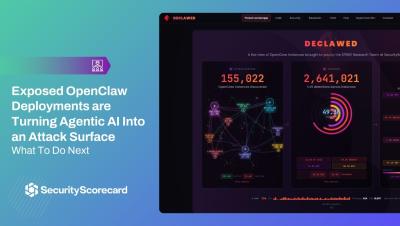
Exposed OpenClaw Deployments are Turning Agentic AI Into an Attack Surface: What To Do Next

SecurityScorecard's STRIKE Threat Intelligence team has uncovered tens of thousands of exposed OpenClaw instances, many of which are vulnerable to Remote Code Execution (RCE). These exposed OpenClaw instances leave users and organizations open to attacks. OpenClaw and other agentic AI tools are designed to take actions on a user’s behalf, interact with infrastructure, and move across connected services. That functionality is the appeal. It is also the risk for users around the globe.

Training Humans and AI Agents

Managing the risks associated with the increasing use of AI agents and co-pilots is critical for every organization. A key challenge is that AI agents draft documents and influence decisions but they operate without a true understanding of a company's rules, culture, or risk. Like humans, AI agents are susceptible to failure. Humans are socially engineered, while AI agents are prompt engineered, and AI agents may "hallucinate" when context is missing, similar to how humans guess.