Security | Threat Detection | Cyberattacks | DevSecOps | Compliance

Training Humans and AI Agents

Managing the risks associated with the increasing use of AI agents and co-pilots is critical for every organization. A key challenge is that AI agents draft documents and influence decisions but they operate without a true understanding of a company's rules, culture, or risk. Like humans, AI agents are susceptible to failure. Humans are socially engineered, while AI agents are prompt engineered, and AI agents may "hallucinate" when context is missing, similar to how humans guess.

Claude Code-powered multi-tenant SecOps for MSSPs | LimaCharlie demo

See how LimCharlie's Agentic SecOps Workspace handles multi-tenant security operations at scale. This demo walks through real-world scenarios that MSSPs face daily: Unlike token-based AI tools that become cost-prohibitive at scale, this platform uses a flat-fee per analyst model. Every capability in your tech stack becomes accessible through AI-powered automation, and you maintain full control with granular permissions.

Sensitive Enterprise Data Is Flowing Into AI Tools at Scale

AI has no-so-quietly shifted from a single interface used by a small group of specialists into a mainstream capability embedded across enterprise infrastructure. Employees are now operationalizing AI for core business functions across departments. This shift fundamentally changes how organizations must think about data security.

AI-Powered Storyboarding: Turning a Script into a 60-Second Concept Trailer in One Afternoon

In the traditional film industry, the distance between a "brilliant idea" and a "visual pitch" is often measured in months and thousands of dollars. After a screenwriter finishes a script, the production team must embark on a grueling journey: hiring storyboard artists to sketch hundreds of frames, scouting locations, commissioning concept art, and perhaps hiring a CGI house to create a rough animatic. For independent filmmakers or small creative agencies, this "development hell" is where most projects die. They simply lack the resources to show stakeholders what the movie will feel like.

AI Agent-to-Agent Communication: The Next Major Attack Surface

We are witnessing the end of the "Human-in-the-Loop" era and the beginning of the "Agent-to-Agent" economy. Until recently, most AI interactions were hub-and-spoke models where a human user prompted a central model, reviewed the output, and then took action. That model provided a natural safety brake. If the AI hallucinated or suggested a malicious action, a human was there to catch it. That safety brake is disappearing.

Exabeam Agent Behavior Analytics: First-of-Its-Kind Behavioral Detections for AI Agents

AI agents are moving into real workflows faster than most teams expected. According to PwC’s 2025 AI Agent Survey, 79% of companies are already adopting AI agents, and 88% of executives expect to increase AI-related budgets in the next year. These agents are now handling research, summarization, customer engagement, and operational tasks at a scale humans can’t match.

0-Click RCE in Claude Desktop: How AI Extensions Threaten Endpoint Security

The modern enterprise software ecosystem increasingly relies on desktop AI applications enhanced through extensible plugin or extension frameworks. These extensions are designed to improve productivity by enabling integrations with local files, browsers, APIs, developer tools, and internal systems. However, this same extensibility introduces a high-risk attack surface when extension permissions, sandboxing, and input validation are weakly enforced.

Using SSL Inspection and AI Guardrails to Protect Infrastructure

Using SSL Inspection and AI Guardrails to Protect Infrastructure How do you protect your AI infrastructure from threats without impacting user experience? In this video, we'll cover the methods organizations can use to inspect encrypted traffic, including what is sent to AI chatbots, and add guardrails to protect against security risks. We'll cover.

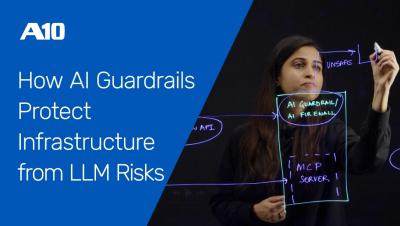
How do AI guardrails protect infrastructure from the unsafe and unpredictable territory of LLM risks

How do AI guardrails protect infrastructure from the unsafe and unpredictable territory of LLM risks? An AI firewall or guardrail device sits between your applications and large language models to keep the data sent and received from LLMs safe, compliant, and high-quality. Its design is to inspect natural-language traffic and protect your infrastructure against LMM vulnerabilities, including prompt injection, jailbreak attacks, data poisoning, system prompt leakage, and OWASP Top 10 vulnerabilities, using advanced, proprietary reasoning models.