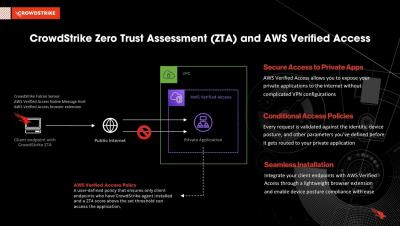
AWS Verified Access (AVA), a feature of Amazon Virtual Private Cloud (VPC) networking, delivers secure, zero-trust access to private applications without a VPN by continuously evaluating each request in real time based on contextual security signals like identity, device security status and location. The service grants access based on the security policy configured for each application and then connects the users, thereby improving the security posture of the organization.
Why should organizations fund zero-trust architectures? The business benefits of zero-trust are significant. By adopting the "never trust, always verify" mindset, organizations shift to a more centralized security management approach, which can result in cost-effectiveness and a stronger layer of protection for resources such as identities, data, and applications.
Tanium and Microsoft reveal more about their value-add for large organizations.
The United States Patent and Trademark Office (USPTO) is the repository for a wealth of knowledge dating back to the nation's founding. The information behind many of the world's greatest inventions ranging from the light bulb, iPhone, Maglev trains to the zipper are housed and protected by the USPTO. A task that is now considerably more difficult as the primary storage medium moves from paper to on-premises and into the cloud.
During every Innovation Week, Cloudflare looks at our network’s performance versus our competitors. In past weeks, we’ve focused on how much faster we are compared to reverse proxies like Akamai, or platforms that sell serverless compute that compares to our Supercloud, like Fastly and AWS. This week, we’d like to provide an update on how we compare to other reverse proxies as well as an update to our application services security product comparison against Zscaler and Netskope.
You’ve heard about it. A lot. But there are quite a few nuances when it comes to how Zero Trust security is defined and discussed. Is it a platform or a principle? It’s one of those terms that’s so widely cited that it has the tendency these days to elicit eye rolls within the cybersecurity industry and to be referred to as a buzzword by those sitting at the cool kids’ lunch table.