Security | Threat Detection | Cyberattacks | DevSecOps | Compliance

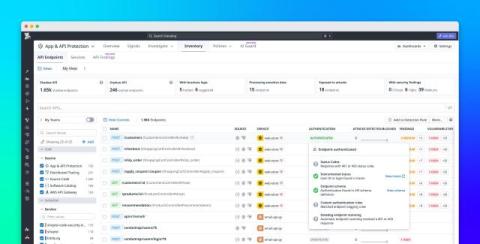
Improve API authentication detection with Datadog

Many organizations have hundreds or thousands of API endpoints across their services, each of which handles authentication differently. For example, one service might rely on standard headers like Authorization: Bearer, while another uses an API key, and a third uses a custom JSON Web Token header with mechanisms or naming conventions specific to the team that built it.
Runtime Observability for AI Agents: What to Instrument and Why

Every guide to AI agent observability tells you what to capture — prompts, tool calls, token usage, traces, syscalls. Almost none address which of those signal sources you can still trust when the agent itself is part of the threat model. That distinction is the entire difference between observability that helps your SRE team debug a slow reasoning chain and observability that helps your security team investigate a breach.

Tranche 2 Australia: Who's affected and how to comply

On 1 July 2026, Australia's Tranche 2 reforms take effect. If you're a lawyer, accountant, real estate agent, conveyancer, precious metals dealer, or trust and company service provider, this deadline likely applies to you. Tranche 2 extends Australia's AML/CTF obligations to approximately 100,000 businesses that were previously unregulated.

SecurityScorecard Weekly Brief: The Driftnet Edition on Critical Infrastructure - Gilad F. Maizles

In this week’s Weekly Brief: The Driftnet Edition, Cyber Researcher Gilad F. Maizles breaks down new SecurityScorecard research powered by the company’s acquisition of Driftnet, exposing widespread internet-facing risk inside a U.S. municipal utility provider that also operated as the town’s ISP. “Threat actors will always target the lowest hanging fruit.” Using the Driftnet engine, SecurityScorecard identified significantly more internet-facing services and attack paths than traditional methodologies.

Understanding continuous threat exposure management (CTEM)

Continuous threat exposure management, or CTEM, is a five-stage program framework for continuously reducing real-world security exposure. It builds on vulnerability scanning by adding risk-informed prioritization, validation of exposure conditions and control effectiveness, and cross-team mobilization to drive remediation.

Prevent Sensitive Data Exposure With Egnyte AI Safeguards

AI Safeguards help you control what AI can see, share, and do, by protecting sensitive content from AI exposure. AI Safeguards’ coverage extends across Egnyte AI Assistant, to AI agents and our MCP Server. Safeguards are available across Egnyte’s mobile, desktop, and web platforms.