Security | Threat Detection | Cyberattacks | DevSecOps | Compliance

Gen AI Pentesting: A Technical Guide for Security Teams

If Gen AI adoption were a drinking game, most companies would be three rounds in and still adding shots. I mean, with a new LLM-powered feature every sprint, agents wired into internal APIs, RAG pipelines indexing everything from Confluence to the HR drive, i.e., fast, exciting, and almost nobody checking what happens when someone hands the model a sentence or a txt.file it wasn’t supposed to receive.

AI vs. AI: Fighting the Next Wave of Cyber Attacks with Ravid Circus

Recently our CMO, Tony Thompson, caught up with Seemplicity co-founder and CPO, Ravid Circus, in Paris to talk about the massive shift in the cybersecurity landscape caused by Claude Mythos. As AI research models like Claude Mythos hyper-scale the ability to identify vulnerabilities and weaponize exploits in minutes rather than months, traditional risk-based vulnerability management must evolve. In this video, you will learn.

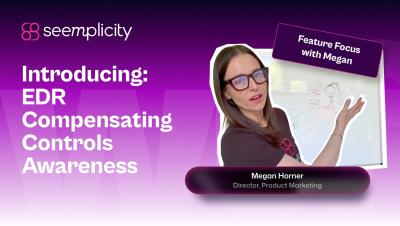
Exposure Management in the AI Era | Introducing EDR Compensating Controls Awareness

In this Feature Focus, Megan Horner, Product Marketing Director at Seemplicity, explores the evolving landscape of vulnerability management in the AI era. As the rise of AI models like Claude Mythos enables attackers to shrink exploit windows, security teams are facing an overwhelming flood of high-priority vulnerabilities.

EDR Compensating Controls Awareness

Are you tired of chasing high CVSS scores that don't reflect your actual risk? In this video, we introduce a new addition to the Seemplicity Exposure Action Platform: EDR Compensating Controls Awareness. This new feature bridges the gap between theoretical severity and verified exposure. By ingesting live telemetry from EDR platforms like CrowdStrike and Microsoft Defender, Seemplicity maps your existing security controls against the specific exploit techniques used by CVEs.

The New Security Risks of the Agentic Development Lifecycle

For years, application security ran on a simple assumption: software moves through a lifecycle, and security inspects the artifacts as they travel from development to production. Developers plan, write code, commit it, test it, scan it, and ship it. Every control built, including pull request reviews, CI/CD gates, and post-commit scanning, assumed a human was sitting between each step, making decisions a tool could later check.

Why Your Security Investment Isn't Reducing Risk (+What Actually Does)

Security budgets have never been higher. The average enterprise now runs 50 security tools, and most teams added more last year than the year before. And yet, alert fatigue is at the breaking point. Coverage gaps in mobile and API environments continue to widen. The exploitability problem at the center of most AppSec programs remains unsolved. Breaches keep happening. Risk scores don't move.

Five Signals, One Answer: Why Single-Signal AI Security Always Fails

The security industry hasn’t been wrong about agentic AI risk. It’s been incomplete. There’s no shortage of single-signal solutions for the problem: tools that analyze prompts for malicious content, platforms that monitor data access patterns, capabilities that assess model behavior for signs of manipulation. Each captures something real. None is sufficient on its own.

How strategic CISOs innovate with AI despite limited resources

In previous Strategic CISOs sessions, I’ve spoken with security leaders from Andesite, IMO Health, and Cribl. They’ve built trusted programs where GRC functions as a business driver and customer assurance accelerates revenue. But every CISO I speak with is still fighting some version of the same fight. They have more obligations, more scrutiny, and more AI-related risk, but they do not have more people, more budget, or more hours in the day.

EDR Compensating Controls Awareness

Seemplicity’s new EDR Compensating Controls Awareness feature reduces vulnerability backlogs by embedding live, asset-level endpoint telemetry directly into remediation workflows. By automatically mapping EDR policy configurations against specific CVE attack techniques, the platform determines if an active endpoint control already neutralizes a threat. Each finding is dynamically assigned a clear protection outcome, complete with an auditable evidence trail.