Security | Threat Detection | Cyberattacks | DevSecOps | Compliance

Forward Networks Wins 2025 Gold Globee for Hybrid Cloud Security Solutions

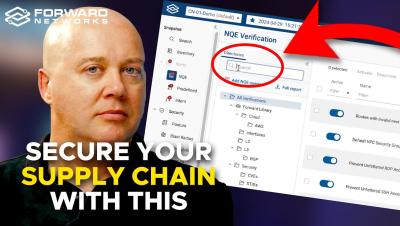
Managing Common Vulnerabilities and Exposures (CVEs) is one of the most daunting challenges for Chief Information Security Officers (CISOs) today. In 2024 alone, over 40,000 CVEs were issued by the National Institute of Standards and Technology (NIST), forcing security teams to sift through an overwhelming volume of threats. With hybrid, multi-cloud networks expanding in complexity, manually identifying, prioritizing, and remediating vulnerabilities have become an unsustainable burden.

Expanding Enterprise Security with the Cato LAN NGFW

With enterprise-wide cloud adoption and the onset of hybrid work, the mission has become clear: to securely connect users to applications — no matter where they are. While solutions like Firewall-as-a-Service (FWaaS), Secure Web Gateway (SWG), and Cloud Access Security Broker (CASB) can protect WAN and internet-bound traffic, anything happening on the internal LAN is in a blind spot.

Microsegmentation That Stops Lateral LAN Threat Movement with the Cato LAN NGFW

Stop Lateral Threat Movement with Cato’s LAN Next-Gen Firewall! Traditional VLAN-based segmentation is no longer enough to stop lateral movement within your corporate network. Attackers exploit east-west traffic, moving undetected between users, devices, and workloads. How do you enforce microsegmentation without increasing operational complexity? Cato Networks introduces L7 LAN NGFW, a native feature of the Cato SASE Cloud Platform that brings application-aware security to your local LAN. It prevents unauthorized access and restricts communication across VLANs without manual configurations or complex ACLs.

Protect Local Networks with Cato's Application-Aware LAN NGFW

Simplify LAN Security with Cato Networks’ LAN Next-Gen Firewall! Managing LAN security across multiple locations has always been a challenge—until now. Two common hurdles IT teams face: Hardware Hassles – Deploying, upgrading, and troubleshooting firewalls at each site is time-consuming and costly. Policy Complexity – Keeping rules clean and consistent across multiple locations can be a nightmare.

Cato CTRL Threat Research: Ballista - New IoT Botnet Targeting Thousands of TP-Link Archer Routers

Over the years, major IoT botnets like Mirai and Mozi have proven how easily routers can be exploited and threat actors have taken note. Two key issues have played in their favor: the fact that users rarely deploy new firmware to their routers, coupled with the lack of regard for security by router vendors. As a result, router vulnerabilities may persist in the wild for much longer than initially expected, even after patches are published publicly.

How Calico Network Security Works

In the rapidly evolving world of Kubernetes, network security remains one of the most challenging aspects for organizations. The shift to dynamic containerized environments brings challenges like inter-cluster communication, rapid scaling, and multi-cloud deployments. These challenges, compounded by tool sprawl and fragmented visibility, leave teams grappling with operational inefficiencies, misaligned priorities, and increasing vulnerabilities.

Critical VMware ESXi CVEs Have No Workarounds - Forward Networks Helps You Detect and Mitigate

The recently disclosed VMware ESXi vulnerabilities pose a serious security risk, enabling attackers to exploit virtualized environments through VM escape, remote code execution (RCE), privilege escalation, and data leakage. With cybercriminals actively targeting these flaws, organizations must act swiftly to secure their infrastructure.

Quick FIX log management: How metadata simplifies financial protocol tracking (and how Corelight's platform can help)

Financial institutions, such as banks and trading houses, have a strong interest in recording key transaction activity within their networks. In the face of daunting data storage requirements, many are finding that Corelight’s network metadata—notably metadata produced by Zeek—is the key to a simplified tracking and storage process. Many of our customers used to rely on packet capture (PCAP).

How metadata wrestled control of FINRA's colossal data archiving requirements

The financial industry is known for its rigorous and sometimes quirky data retention requirements that can challenge even the most seasoned security expert. For example, FINRA Rule 4511 requires members to "preserve for a period of at least six years those FINRA books and records for which there is no specified period under the FINRA rules or applicable Exchange Act rules." Keeping six years of records: That's no small feat. But it's certainly doable.