Security | Threat Detection | Cyberattacks | DevSecOps | Compliance

Automating Kubernetes Cross-Account and Cross-Cluster Restore

Why settle for less! The challenge of manually dealing with self-hosting a product like Velero or Kasten on dozens of clusters and multiple clouds, and then trying to migrate data across different accounts and even different clouds is very different from dealing with a single cluster and a single cloud environment. CloudCasa provides a guided workflow for cross-account and cross-cluster Kubernetes restores in Amazon EKS from an intuitive GUI.

Adapting security to Amazon EKS Anywhere on Bare Metal

Amazon EKS Anywhere (EKS-A) on Bare Metal is a new deployment option for Amazon Elastic Kubernetes Service that launched this week. Why bare metal? In the age of the cloud it would seem to go against “best practices.” On the contrary. While we tend to overuse the term, “hybrid cloud,” it is a real thing. Enterprises come in all shapes and sizes — and so do their compute choices and privacy requirements.

5 reasons why Sysdig partners with Proofpoint to enhance cloud security

At Sysdig, we are constantly looking for ways to improve the security posture of the organizations that we work with. One of the areas we continuously improve upon is our platform’s threat intelligence and detection capabilities that leverage the open-source Falco project. We incorporate threat intelligence sourced from our own strategically placed honeypots, data collection systems, and multiple other open-source feeds.

Preventing container runtime attacks with Sysdig's Drift Control

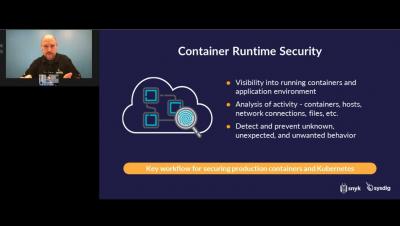
Containers revolutionized how we build, deploy, and run applications with increased speed, agility, and scalability. But, as often happens with transformative technologies, they require an evolution to security strategy. Centralized deployments inside a protected perimeter gave way to continuous and distributed deployment of containers, creating a growing, dynamic, and distributed attack surface. IT and security teams were left blind and exposed in the cloud.

What have we learned from scanning over 10,000 Kubernetes clusters with Kubescape?

With Kubernetes adoption continuing to rise, we've seen multiple studies add to the growing body of research for enterprise K8s deployments this past year. Companies leveraging managed services and packaged platforms drive much of the continued growth in adoption. An annual study conducted by the Cloud Native Computing Foundation (CNCF) found that 96% of organizations surveyed are either using or evaluating K8s currently.

How to Secure AWS Route 53 with Sysdig

Either through human error or intentionally, configuration changes in the cloud may suddenly increase your attack surface. AWS Route 53 is an example of a service that needs to be continuously tracked for risky changes. As the first line of defense of our cloud, it is necessary to secure Amazon Route 53 and monitor risky configuration changes to avoid unwanted surprises. As you probably know, AWS Route 53 is of course a very popular DNS service offered by AWS, with millions of top-level domains.

Secure your cloud from source to run

Security is changing, you need to adapt to the Cloud. Sysdig: Secure your Cloud from Source to Run. Cloud security that avoids, that alerts, closes gaps, grants access, takes charge. That checks out, that scales up, that keeps up. That’s there From source, to run. That’s Sysdig! A single view of risk. With no blind spots. Rich context to prioritize what matters. With no guesswork. A platform based on open standards. With no black boxes.

Zero trust for cloud-native workloads: Mitigating future Log4j incidents

In my previous blog, I introduced the brief history of zero trust, the core pillars of a zero-trust model, and how to build a zero-trust model for cloud-native workloads. In this blog, you will learn how Calico can help mitigate vulnerabilities such as the recent zero-day Log4j vulnerability with its zero-trust workload security approach.

Safely handling containers

Snyk Ambassadors are passionate about sharing their security expertise. Become one today by signing up! In the shipping industry, the container format follows ISO 668, a standard format that regulates the safe stacking of containers. Imagine your applications with multiple containers, running different applications, serving different purposes for people all over the world.