Security | Threat Detection | Cyberattacks | DevSecOps | Compliance

Cyber Resilience Act is here! Myth busting and first impressions

The first deadline of the Cyber Resilience Act went live last week. The Cyber Resilience Act (CRA) is the new EU regulation that defines minimum cybersecurity requirements for all products with digital elements, including their building blocks (hardware and software). It applies to anyone placing products on the EU market, not just companies based there. The full requirements won’t go into effect until the end of next year.

The Agent Will See You Now: Why Healthcare's AI Agent Boom Needs Visibility and Control

Ask AI to Choose a prompt Write a TLDR of this post Explain the security risk Summarize what CISOs should know Healthcare, as an industry vertical, is moving faster on agentic AI than it has in past technology evolutions. Some reports say it is outpacing other regulated industries. Ambient scribes are documenting patient visits in real time. Prior-authorization and revenue-cycle agents are handling payer workflows that used to require staff to log into multiple systems manually.

Remote Work Security & Endpoint DLP: How to Prevent Exfiltration on Distributed Laptops

The corporate security perimeter has changed. An employee’s company laptop could easily arrive at work on a Monday morning connected to a home Wi-Fi network, then land in a hotel or workspace at noon on a Tuesday and work away from a hotspot on Wednesday. That leaves corporate data outside the reach of traditional IT and security controls.

What Is Cybersecurity? Types, Threats, and Best Practices

As more businesses are becoming dependent on technology, the role of cybersecurity is more crucial than ever. With so many systems and applications in use, it is difficult to manage and protect devices and data against cyberattacks and unauthorized access. No single tool or team can secure an organization alone. Businesses today use cloud platforms, third-party applications, and remote endpoints, which increase the attack surface.

Graphalgo campaign spreads to Terraform providers and Go Modules

We’ve identified Go malware distributed via at least two Terraform providers and at least two Go Modules. This is the first time we’ve observed malware distributed via Terraform providers. The following packages contain the malware: The malware overlaps with the Graphalgo NPM malware campaign, first reported by ReversingLabs in February 2026, and also reported on in the last week by Safedep, CheckMarx, and JFrog.

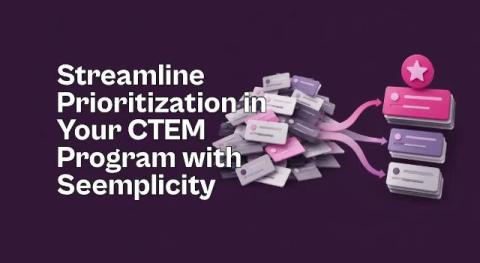
Streamline Prioritization in Your CTEM Program with Seemplicity

Prioritization in CTEM is the process of determining which exposures should be addressed first based on the risk they pose in your specific environment. Rather than relying on severity scores alone, effective prioritization combines internal business and asset context with external threat intelligence, then focuses teams on the fixes that reduce the most meaningful risk.

6 Best Server Virtualization Platforms for Financial Services

Financial services teams don't have room for downtime or loose audit trails - server virtualization has to hold up under both. But the pressure points are predictable: VM sprawl quietly eats resources, licensing gets tangled across changing environments, and high-density workloads expose weak spots fast. We reviewed platforms across deployment scale, performance consistency, and enterprise adoption to narrow it down to six worth considering for financial services environments.

The Best US-Based Penetration Testing Companies for 2026

Choosing a penetration testing company is one of the more consequential security decisions an organization makes. A penetration test is a controlled, authorized attempt to find and safely demonstrate the security weaknesses in your systems, carried out by skilled professionals who think the way real attackers do. The quality of that testing directly affects how well you understand your own security, and a good provider finds the weaknesses that matter while a weak one leaves you with a false sense of safety.

Quantum Computing and the Future of Security: What Teams Should Understand Now

Quantum computing is one of the most hyped topics in technology, and for security professionals it carries a particular weight. Beyond the general excitement about a new kind of computing lies a specific and serious question: what will quantum computers mean for the security we rely on today? Much of the encryption that protects data, communications, and systems rests on mathematical problems that ordinary computers cannot solve in any practical amount of time. Quantum computers, at least in principle, could one day solve some of those problems, which would have real consequences for security.