Security | Threat Detection | Cyberattacks | DevSecOps | Compliance

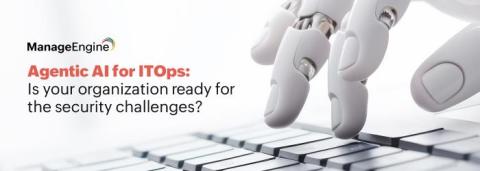
Agentic AI for ITOps: Is your organization ready for the security challenges?

AI is set to provide increasing value in IT by enabling more ways to simplify complex IT operations, offering actionable insights, automating routine tasks with context-aware automation, and detecting abnormal events with advanced machine learning algorithms. With agentic AI, systems can understand what is happening in an IT environment, reason about the most probable root causes, determine the right course of action, and implement these changes without requiring additional human intervention.

Attackers Have Changed Their Playbook. Has Your Security Strategy Changed With Them?

Cybersecurity teams have spent years preparing for malware, ransomware, and high-volume attacks. Yet the latest WatchGuard Global Threat Report reveals a more nuanced and potentially more dangerous reality: attackers are becoming quieter, more evasive, and increasingly reliant on stolen credentials, legitimate tools, encrypted communications, and long-known vulnerabilities. For MSPs and IT leaders, the challenge isn't simply understanding these trends.

Your Security Team Is Stretched Thin. Can AI Return the Hours?

The Arctic Wolf 2026 AI & Cybersecurity Trends Report asked security leaders how much time their teams spend each week on nine separate security tasks, and the answer came back between 13 and 15 hours for each one. That’s a workload that adds up to roughly three full-time people before anything unplanned arrives. Leaders are already acting on the problem.

Engineered for Trust: How We Built the AI Trust Engine

The rapid advancement of frontier AI models has fundamentally changed how security products are built. Capabilities that once took months to develop can now be delivered at machine speed, and the market is filling up with agentic security operations centers (SOCs). Numerous vendors now promise AI agents that can investigate alerts, correlate evidence, reason over complex signals, and even close incidents on their own. The technology appears capable, but what often gets left out is a reason to believe it.

The answer to AI uncertainty is adaptability, not paralysis

AI uncertainty is not a strategic reason to wait; it is a strategic imperative to build adaptable organizations that can innovate confidently, govern risk proportionately, and respond effectively as technology and threats evolve. Every few weeks, the AI conversation seems to reset around a new warning. A model demonstrates an unexpected capability. An autonomous agent behaves in a way its designers did not anticipate. A new forecast describes how quickly AI could transform work, security or society.

The Fragment Is the New Attack Surface

Most security tools evaluate risk by looking at the file, but risk is no longer confined to files. A clause pasted into an AI prompt carries no filename. A table summarized into Slack carries no label. A screenshot dropped into a deck carries no metadata, yet none of these trip an alert, because legacy data loss prevention (DLP) was built for a world where the sensitive unit is a discrete object with a name, a location, and a policy attached to it. That world is gone.

Why Severity Scores Don't Tell the Full Risk Story

Security teams have long relied on severity scores to prioritize vulnerabilities, but severity alone doesn't reveal which exposures pose the greatest immediate risk. This video explores why factors like asset criticality, reachability, and time-to-danger are becoming essential for effective vulnerability prioritization, helping teams focus on the risks that matter most.

CrowdStrike SafeMind: When the Best Offense Builds the Best Defense

The conventional approach to AI-powered security is to build an offensive agent to find weaknesses, build a defensive agent to catch threats, and run them in separate tracks. It's a clean division of labor that produces capable tools. However, the conventional approach also produces a permanent blind spot — the defense is never trained against the actual offense, and the connective tissue between the two is manual, slow, and fragile.