Building the Post-Mythos Security Organization: From Episodic Security to Continuous Assurance

In an era where AI accelerates both innovation and adversarial capability, security leaders are confronting a difficult reality: traditional approaches to cyber defense are no longer sufficient. Cyberhaven’s Office of the CISO is responding with a forward-looking strategy designed not simply to keep pace with emerging threats, but to fundamentally redefine enterprise readiness in a post-Mythos world.

Govern AI agents the right way with Identity Manager by One Identity

AI agents are becoming an inseparable part of identity governance, sometimes being created by other AI agents and acting proactively across platforms at machine speed — but who’s watching them? Identity Manager 10.0 by One Identity answers that question. Hear Ingrid Thorpe, director of product management for Identity Manager, explore how the solution governs agentic workflows, tackles agent-specific risks and integrates across cloud and enterprise platforms, holding non-human identities (NHIs) accountable.

VMware to Hyper-V Migration with Microsoft Virtual Machine Converter (Step-by-Step)

In this video, you’ll learn how to migrate a VMware virtual machine to Microsoft Hyper-V using Microsoft Virtual Machine Converter (MVMC). The walkthrough covers two real-world migration scenarios: Migrating a VMware VM from an ESXi host using the MVMC GUI Converting VMware virtual disks to Hyper-V format using PowerShell cmdlets The example VM runs Windows Server 2019, and the video explains key prerequisites such as uninstalling VMware Tools, checking the boot mode (BIOS or UEFI), and choosing the correct Hyper-V VM generation.

Next.js Vulnerability Exposes Credentials and Protected Data - Why Runtime API Security Matters

A newly disclosed security issue, tracked as CVE-2026-44578, affecting Next.js applications is raising concerns across the developer and security communities after researchers identified multiple authorization bypass and middleware evasion paths that could expose protected application data and credentials. The vulnerabilities impact several versions of Next.js and allow attackers to bypass middleware-based authorization controls using crafted requests and route manipulation techniques.

Your Browser Is Stealing Your Data Right Now

In this video, you will learn how lightweight OS-level instrumentation binds lineage metadata to clipboard content the moment data is copied, how that tag survives edits, reformatting, and translation across applications, and how provenance-based policy replaces pattern matching with precision rules tied to the actual source of the data. You will also learn how pairing network tools with a browser extension captures user intent before encryption, eliminating the alert fatigue that buries real risk in noise.

The MSP Evolution: From IT Support to Cybersecurity Leadership

For years, managed service providers (MSPs) have played a critical role in helping businesses maintain and support their IT environments. But today, the market is demanding something fundamentally different. Cybersecurity has become a continuous operational challenge, one that many SMB and midmarket organizations can no longer manage alone.

Why strategic CISOs need proactive risk reduction, not reactive GRC reporting

Security and GRC teams have no shortage of risk mitigation activities. They are carrying more work than ever, yet many still lack confidence in the data and recommendations produced by all that manual effort. They are also operating in a risk environment that changes faster than their current operating model was designed to support. Unfortunately, the existence of risk activity does not mean actual risk has been reduced.

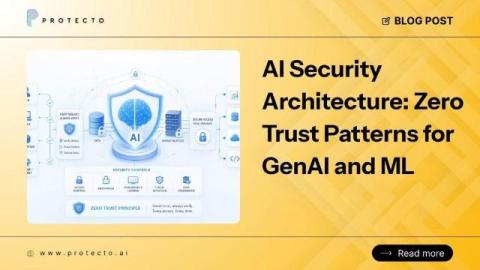
AI Security Architecture: Zero Trust Patterns for GenAI and ML

There is no doubt that AI, or Artificial Intelligence, is rapidly changing how businesses are operating. However, it also brings new risks when it comes to data. As per industry reports, 72% of companies mention that there has been a significant increase in organizational cyber risks. It is therefore necessary to have a strong AI security architecture that helps to protect sensitive information. In light of this, 85% of organizations are now increasing their cybersecurity budget.

Guarding the Manufacturer's Core: Securing Intellectual Property in the Age of AI at Renesas

Organizations like Renesas face critical risks when utilizing AI, as these platforms often incorporate user-submitted data into their models. Significant security incidents have occurred where sensitive source code, firmware, and proprietary designs were inadvertently made public after being uploaded for testing. A major business risk involves the potential loss of intellectual property, which can directly impact an organization's primary revenue streams. Beyond data leakage, AI presents risks through "poisoning" and the fact that AI-generated output is frequently inaccurate.