Security | Threat Detection | Cyberattacks | DevSecOps | Compliance

Snyk uncovers malicious code activities in open source supply chain security on the npm registry

Open source helps developers build faster. But who’s making sure these open source dependencies (sometimes years out of development) stay secure? In a recent npm security research activity, Snyk uncovered a total of 8 npm packages which matched a specific malicious code vector of attack. This specific attack vector of the malicious packages included packages which had pre/post install scripts, which allowed them to run arbitrary commands when installed.


GitHub Security Code Scanning: Secure your open source dependencies

We are happy to announce Snyk Open Source support for GitHub Security Code Scanning, enabling you to automatically scan your open source dependencies for security vulnerabilities and license issues, as well as view results directly from within GitHub’s Security tab! A key ingredient of Snyk’s developer-first approach is integrating Snyk’s security data into the exact same processes that developers are using, whether this is within a developer’s IDE or a Git-based workflow.

A hacker's approach to finding security bugs in open source software

Spencer Pearlman, Security Researcher at Detectify, presented A Hacker’s Approach to Finding Security Bugs in Open Source Software in a partnered webinar with friends at Debricked. Securing modern web applications takes new approaches, and this includes looking at it from a hacker’s perspective. Here are highlights from the presentation on how tech teams can apply the same hacker mindset to discover vulnerabilities in open-source software in their tech stack.

SolarWinds Orion Security Breach: A Shift In The Software Supply Chain Paradigm

The recent SolarWinds breach highlights a new paradigm in the Software Supply Chain. When compared simply to the code itself without any additional tools, Proprietary Code is no more secure than Open Source. By contrast, many would argue that Open Source Code is more secure due to a faster fix/patch/update cycle and the pervasive access to source code (Clarke, Dorwin, and Nash, n.d.).

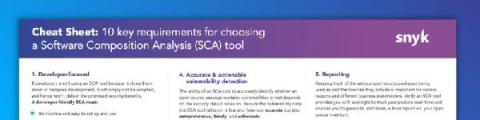
How to choose a Software Composition Analysis (SCA) tool

Whether you’re a developer or a security engineer, Software Composition Analysis—or SCA for short—is a term you will start to hear of more and more. If you haven’t already, that is. The reason for this is simple. Your company is increasingly relying on open source software and containers to develop its applications and by doing so is introducing risk in the form of security vulnerabilities and license violations.

Three Open Source Software Security Myths Dispelled

Used by developers around the world, open source components comprise 60%-80% (and likely more) of the codebase in modern applications. Open source components speed the development of proprietary applications, save money, and help organizations stay on the cutting edge of technology development. Despite the widespread adoption of open source components, myths persist about its usage. The following are the top three concerns associated with open source use.

Best Server Monitoring Software Tools

If you don’t know the state of your network and server health every second of the day, you’re like a blind pilot inevitably headed for disaster. Fortunately, the market now offers many good tools, both commercial and open source, for network and Windows Server monitoring. We’ve put together a list of best open source, free and paid Windows Server monitoring tools that have proven their value in networks of many sizes.

Open Source Licenses in 2021: Trends and Predictions

As this year comes to a close, it is a good time to take a look at the trends of open source license usage in 2020 and compare them to previous years. Our research team has collected information from the WhiteSource database, which includes more than 4 million open source packages and 130 million open source files covering over 200 programming languages, to learn which were the most popular open source licenses in 2020.

Coralogix - Panel Discussion: Elasticsearch is Not Open Source Anymore

Does SSPL license endanger your intellectual property? As of January 2021, Elasticsearch is no longer open source. From version 7.11 and onwards, all ELK products (Elastic, Logstash, Kibana) will be registered under the new SSPL license created by Mongo and now adopted by Elastic. In this panel, our IP expert lawyer discusses the new license and helps explain whether it impacts your business or puts it at risk.