Security | Threat Detection | Cyberattacks | DevSecOps | Compliance

Why EDR and proxy won't save you from supply chain malware

Most security teams check the EDR box, check the proxy box, and move on. Against supply chain malware, neither provides meaningful protection because they were built for a different problem. Traditional malware has a way of sneaking onto a machine, whereas supply chain malware gets invited. The developer runs npm install, and the malicious code lands with full permission to execute. That inversion breaks both tools at the design level. ‍

How OEMs can deliver safer, recoveryready systems in an evolving OT landscape

OEM expectations have shifted. High performance is no longer enough, and systems must stay resilient for years or even decades across complex environments. Evolving cyberthreats and stricter regulations are increasing complexity. With legacy systems lasting longer and frameworks like the EU Cyber Resilience Act and IEC 62443 raising the bar, prevention alone no longer cuts it. Recovery readiness ensures fast, predictable restoration with minimal disruption.

What Every CISO Needs to Know About AI-Assisted Development

There’s a conversation happening in boardrooms, security operations centers, and developer standups that I find both thrilling and concerning: the conversation about AI-assisted development. Engineering teams are shipping features in hours that once took months. Products that would have required six-month roadmaps are being prototyped in a weekend.

How to Stop AI-Driven Data Loss

AI is reshaping the modern workplace. From automating tasks to generating in-depth research in seconds, AI tools are enhancing productivity at a lightning pace. GenAI assistants, agentic browsers, and automation platforms are everyday tools that employees are interweaving into their daily workflows. However, with this powerful new capability comes the serious risk of data loss.

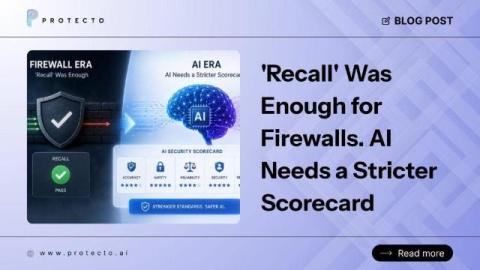
'Recall' Was Enough for Firewalls. AI Needs a Stricter Scorecard

For much of security history, one metric dominated: recall. Recall means: of all the sensitive data that exists, how much did you catch? If there are 100 pieces of PII in a document and your system finds 95, your recall is 95 percent. This made sense in the old security world. If a firewall missed a real threat, the company had a serious problem. If it blocked something safe, someone could investigate and fix it.

Gartner Names Torq as Company to Beat in AI SOC Agents for Threat Investigation in May 2026

See how Torq harnesses AI in your SOC to detect, prioritize, and respond to threats faster. Request a Demo The AI SOC category just got its definitive race assessment, and Torq is at the front. In the May 2026 Gartner report AI Vendor Race: Torq Is the Company to Beat in AI SOC Agents for Threat Investigation (Document ID: G00855833), Gartner names Torq the Company to Beat.

Trusted AI Adoption (Part 2): Detection

It’s Monday morning. Your coding agents ran all weekend. Your security dashboard shows the exact same numbers it did Friday afternoon. Same models, the same approved Model Context Protocol (MCP) servers, the same AI assets you are familiar with. Reassuring. Then, suddenly, you get a notification: a production deploy failed an audit. The build references a model nobody on your team registered.

May Release Rollup: Egnyte Actions, Metadata Enhancements and More

Whether you're managing content across distributed teams, navigating complex governance requirements, or looking for smarter ways to use AI, this month's updates have something for you. You can also join the Egnyte Community to get the latest updates, chat with experts, share feedback, and learn from other users.

KubeFed Explained: Kubernetes Federation Guide

Running one Kubernetes cluster is complex enough. Running five across AWS, GCP, and an on-prem data center without a unified control plane gets painful fast. Kubernetes Federation v2 (KubeFed) was built to solve this problem: managing federated Kubernetes clusters from a single point of control and distributing workloads across regions and providers without duplicating YAML files for every environment.

What Mexico's RFC waiver means for identity verification in banking

In April 2026, Mexican President Claudia Sheinbaum announced that individuals will no longer need a Federal Taxpayer Registry (RFC) number to open an N2 or N3 bank account. As the country continues its transition to cashless payments, this move has the potential to bring more than 32 million unbanked, informal workers into the financial system. But it doesn’t come without risk.