Security | Threat Detection | Cyberattacks | DevSecOps | Compliance

Syteca's approach to stopping a #breach in progress | #pam #itdr #cybersecurity

Prevention is great, but it’s just the front door. Syteca is built for the reality that someone will eventually get inside. Our approach is to move from passive logging to active 'Auto-Containment'. Because our is reinforced with native , the platform doesn't just send an alert when it sees lateral movement or a risky command — it can automatically terminate that session or block the user instantly. We make containment a real-time technical action rather than just a post-incident manual process.

How does Syteca's #ITDR change the way we handle hashtag#incidentresponse? | Syteca PAM

It shifts your team’s response strategy from reactive to proactive. Traditional tools might tell you a credential was used, but Syteca’s ITDR tells you how it was used. Get real-time insights and visibility into privileged sessions, or review session recordings afterward to gain context. With Sensitive Data Masking to protect personal information during an investigation, Immutable Logs, and searchable history, your team can reconstruct a full incident timeline in minutes. provides the forensic-grade evidence needed to prove regulatory while simultaneously stopping attacks in their tracks.

From Endpoint Visibility to Business ROI: Why Workforce Analytics Is Becoming A Boardroom Priority

In most organizations, the largest line item on the balance sheet isn’t technology, it’s people. Labor accounts for 70% of total operating expenses in most SaaS businesses, yet executives often lack a clear view of how that investment translates into productivity, risk exposure, software utilization, and operational efficiency. At the same time, organizations are facing a new wave of hidden costs: These blind spots quietly drain millions from operating budgets.

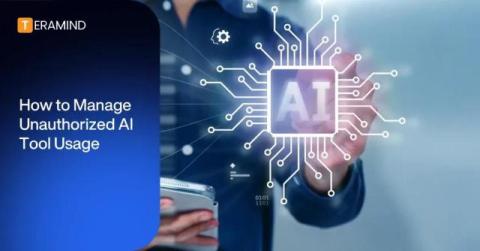
How to Manage Unauthorized AI Tool Usage in Your Business

In only a few years, artificial intelligence (AI) has changed almost every aspect of life, and especially so in business. Today, employees are using generative AI tools to draft emails, code software, and analyze data at lightning speed. However, there is a hidden side to this productivity boost: unauthorized AI use. Many employees are bypassing official IT channels and using shadow AI applications to get their work done.

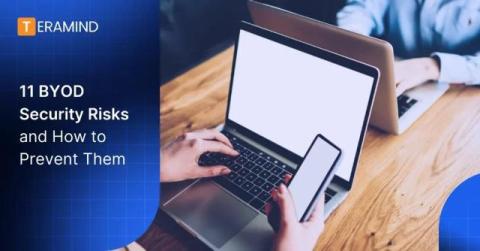
BYOD Security Risks: How to Protect Your Business

It’s tempting for organizations to let employees use their devices for work. It saves money, is convenient for users, and allows corporate network access from remote locations. However, “bring your own device” (BYOD) arrangements can lead to serious security risks compared to issuing company-owned devices. In this post, we’ll assess the main BYOD security risks and explain how you can prevent them.

The 10 Types of Insider Threats Every Security Team Needs to Know

Insider threats account for 34% of all data breaches, yet most organizations are still building security programs designed to stop attackers from the outside. The harder truth? The risk is already inside your walls, and it doesn't always look like a criminal. Not every insider threat is malicious. Some are distracted. Some are overworked. Some are just trying to get things done faster.

Proactive Insider Risk Management: The Smartest Cybersecurity Investment for 2026

One reality that organizations must accept in 2026 is that insider risk can no longer be a secondary security concern. It is a material business risk with direct implications for governance, operational resilience, and enterprise value. Source: 2025 Cost of Insider Risks Global Report by Ponemon Institute.

NIS2-Compliance Webinar: Praktische Schritte mit PAM & ITDR | Syteca Webinar

Die NIS2-Richtlinie verändert die Cybersecurity-Anforderungen in Europa grundlegend. Organisationen müssen strengere Governance-Regeln erfüllen, Sicherheitsvorfälle schneller melden und stärkere Identitätssicherheitsmaßnahmen implementieren. In diesem Webinar zeigen Syteca-Experten, wie Unternehmen von theoretischer Compliance zu einer praktischen Umsetzung gelangen können – mit Privileged Access Management (PAM) und Identity Threat Detection and Response (ITDR).

From Detection to Response: Managing Insider Risks in Healthcare

Watch our expert webinar aimed to help healthcare organizations detect, respond, and manage insider risks effectively - while ensuring compliance with HIPAA standards. Discover how a “Detection to Response” strategy can protect sensitive patient data and maintain operational resilience.

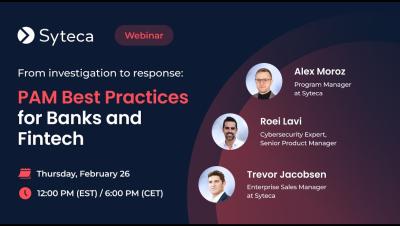
From Investigation to Response: PAM Best Practices for Banks and Fintech

Watch our cybersecurity webinar to discover how banks and fintech organizations can implement PAM best practices with confidence - bringing together detection, investigation, and response stages while meeting demanding compliance requirements. You’ll learn the following key topics: How financial organizations deal with PAM incidents. How to build an advanced PAM + ITDR framework. An investigation-to-response cybersecurity strategy with Syteca. Real-world case studies demonstrating how financial organizations protect critical infrastructure. Live demo: see Syteca PAM + ITDR in action.

14 Best Practices for Data Breach Prevention

For many organizations, a single security lapse isn’t just a technical glitch — it’s a catastrophic blow to their brand reputation and bottom line. With the global average cost of a leak reaching record highs ($4.44 million according to 2025 estimates), learning how to prevent data theft has shifted from a best practice to a business necessity. But how do you stay ahead of the latest cyber threats?

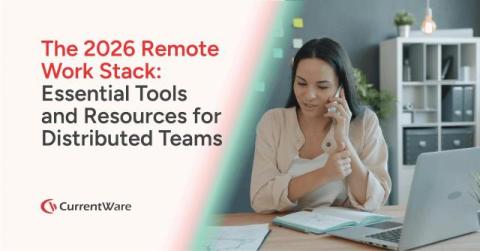
The 2026 Remote Work Stack: Essential Tools and Resources for Distributed Teams

Building a remote team is easy. Scaling one without losing your mind—or your data—is the hard part. As a team that has spent a decade in the trenches of the "Workforce Analytics" world at CurrentWare, we’ve seen the same pattern repeat: companies transition to remote work, they nail down their communication (Slack), they secure their perimeter (VPNs), and then they hit a wall. That wall is Operational Friction.

Five Activities That Indicate an Early Insider Threat

Most insider threats do not start with obvious intent. They start with small changes: A file gets downloaded that does not need to be or a user accesses data outside their usual scope. Information gets shared in ways that feel slightly off. Each action on its own can look harmless, but together, they point to insider risk. That is what makes insider threat indicators hard to catch for security teams. You are not looking for a single violation. You are looking for patterns in how people interact with data.

How Keeper Helps Reduce Insider Threats in Healthcare

Insider threats in healthcare often originate from trusted employees, third-party vendors or contractors who have standing access to critical systems. When privileged access is not closely monitored, healthcare organizations face significant consequences, including compromised patient safety, exposure of Protected Health Information (PHI), disruption to clinical operations and Health Insurance Portability and Accountability Act (HIPAA) compliance violations.

Your AI Just Became the Insider Threat | CrowdStrike Global Threat Report 2026

Hackers can reach your critical systems in just 27 seconds. In 2025, AI-powered cyberattacks surged 89% as adversaries weaponized the same AI tools organizations use every day. From eCrime groups to China-nexus actors, North Korean operatives, and Russian intelligence, AI is accelerating and reshaping global threat activity. In this video, you’ll learn: Adversaries are not just using AI. They are weaponizing your AI against you.

Defeating the deepfake: stopping laptop farms and insider threats

Trust is the most expensive vulnerability in modern security architecture. In recent years, the security industry has pivoted toward a zero trust model for networks — assuming breach and verifying every request. Yet when it comes to the people behind those requests, we often default back to implicit trust. We trust that the person on the Zoom call is who they say they are. We trust that the documents uploaded to an HR portal are genuine. That trust is now being weaponized at an unprecedented scale.

Insider Threat Prevention: Steps, Types & Detection Tools

When security leaders talk about risk, the conversation usually drifts toward ransomware gangs, zero-day exploits, or state-sponsored actors. Fair enough. Those threats are loud and visible. Yet many of the most damaging breaches begin somewhere quieter. Inside the organization. An employee exporting a customer database before resigning. A contractor reusing credentials across systems. A system administrator with broad privileges and very little oversight.

Asset Misappropriation: Warning Signs and How to Prevent It

Keeping money and ideas safe from outsiders is relatively easy. But what happens when you have to keep them safe from insiders? This is when you need to know about asset misappropriation. In this article, we’ll explain what asset misappropriation is and what steps you can take to prevent it. Be ready to take notes! Find out how Teramind stopped a case of employee fraud at Arrivia – watch our video for more insights.

Tech Talk | Print, Leak, Repeat: UEBA Insider Threats You Cant Ignore

Insider threats thrive in ambiguity. They exist in the space where everyday work and malicious intent overlap. Traditional defenses are not built to detect that overlap, they are built to stop outsiders, not to question the behavior of insiders who look legitimate until the moment they are not. User Entity and Behavior Analytics (UEBA) fills that gap by establishing a behavioral perimeter around every identity and device.