Security | Threat Detection | Cyberattacks | DevSecOps | Compliance

The AI SOC explained: Intelligent security for modern threats

The SOC was originally designed for a threat landscape that no longer exists. Today, the sheer number and speed of modern threats make it tough for even the best analysts to keep up. Manually sorting through huge amounts of data, dealing with alert fatigue, and relying on fixed rules make it harder to understand the full story behind each threat. The AI SOC addresses this problem, but not in the way most vendors describe. It’s not just a simple product or feature.

See, Govern, and Secure All AI Usage in Your Enterprise

Do you happen to know which AI tools your employees are using right now, or what data they're sending into them? Cato AI Security automatically discovers every AI application in your environment, provides security teams with session-level visibility into how those tools are being used, and enforces data policies in real time, so employees can keep working and sensitive data stays where it belongs.

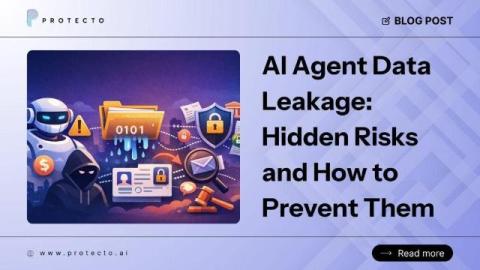
AI Agent Data Leakage: Hidden Risks and How to Prevent Them

AI or artificial intelligence has significantly altered how we work. From customer support bots to internal copilots, they help teams move faster and smarter. But there is a growing concern that many companies are still not ready for. It is data leakage in AI. When an AI agent accidentally or unknowingly shares private information with the wrong person or another system, it is called a data leak. When AI systems handle sensitive data, even a small mistake can expose private information.

How to Gain Value from AI in Cybersecurity

The Terminator is often people’s reference point for artificial intelligence (AI), especially when they worry that technology will be the end of civilization. However, on the other end of the AI spectrum is the beloved, marshmallow fluff Baymax, the helper robot providing assistance to those in his presence. The reality of AI sits somewhere between these two extremes. For security teams, AI initially seemed like a revolutionary technology that would offer faster detection and automated analysis.

How Charlotte AI AgentWorks Fuels Security's Agentic Ecosystem

The era of human-speed defense is over. With eCrime breakout times collapsing to as fast as 27 seconds and attacks from AI-powered adversaries increasing 89% year-over-year, the traditional SOC has reached a breaking point. Manual processes, fragmented tools, and rule-based playbooks were built for a different era. Today, if your defense depends on human reaction time, you’re not just behind — you’re at risk.

Unify Kubernetes, VMs, and AI with VCF 9

Managing modern IT infrastructure often feels like balancing completely different ecosystems. For years, organizations have run separate, hand-built, Kubernetes stacks on top of legacy virtualization platforms. Due to security concerns, it just made sense to build a separate, tailored container environment that they could automate and schedule their exact needs. This fragmented approach leads to inconsistent security policies, fragile integrations between clusters, and operational silos.

Why Your Human Risk Management Strategy Can't Ignore AI

AI isn’t just another technology wave—it’s a force multiplier for both innovation and risk. In a recent webinar featuring insights from Bryan Palma and guest speaker Jinan Budge, Vice President and Research Director at Forrester, one message came through clearly: the rise of AI and AI agents is fundamentally reshaping the human risk landscape—and security leaders need to move fast to keep up.

Top Generative AI Security Risks In The Enterprise

Enterprise security teams spent years building data loss prevention (DLP) programs around a predictable set of egress channels: email, USB drives, cloud storage, and sanctioned SaaS apps. Generative AI has rewritten those assumptions almost overnight. Today, the same data those DLP controls were built to protect is flowing into AI interfaces that most organizations have no visibility into and no enforcement capability over.

From Discovery to Defense: Why AI Red Teaming Is the Next Step After AI-SPM

This week, we announced the general availability of Evo AI-SPM, the first operational layer of Snyk’s AI Security Fabric. AI-SPM gives security teams something they’ve never had before: a system of record for AI risk, with the ability to discover models, frameworks, datasets, and agent infrastructure embedded directly in code. For many organizations, that discovery step is a breakthrough.

Trustworthy AI Starts with Better Agents

The difference between an AI feature and an AI-led operating model becomes clear the moment a security problem becomes difficult. In real-world security operations — where the signal is ambiguous, the evidence spans multiple domains, and the attacker is behaving in unfamiliar ways — architecture matters much more.