Mailchimp
Not subscribed to OpsMatters Newsletter


A modern business needs to secure both physical networks and mobile devices. Here's what you need to know about mobile threat defense services.
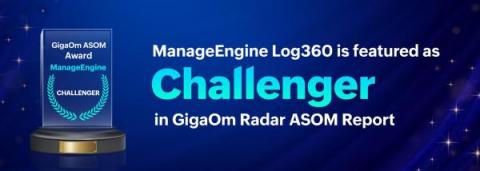
ManageEngine Log360 was featured in the GigaOm Radar report on Automated Security Operations Management (ASOM), published in October 2022 and written by Logan Andrew Green. The research firm’s report includes an in-depth study of the solutions offered by some of the major vendors in the market and highlights Log360 as a Challenger in the ASOM sector. Log360 is a unified SIEM solution from ManageEngine with integrated DLP and CASB capabilities.
With February upon us, we can all feel the love in the air. But no matter what kind of love you’re celebrating, you and yours deserve a place to keep your secrets safe – from love letters to passwords.
Online dating is one of the fastest-growing industries in the tech world. Online dating has quickly become a sustainable way to remain social and have a relationship with someone other than your cat. But what are the chances that you’ll be swiping right on a hacker? Mobile analytics platform, Adjust, reports that in 2021, 300 million adults used dating apps worldwide with 20 million users paying for premium features.
Low-code and no-code technologies are being embraced across the world, but there’s one LCNC platform that stands out, with significant growth and enterprise adoption – and that’s Microsoft’s Power Platform.
Imagine a world where a single line of code, tucked away in a common library or framework, could bring your entire digital world to a screeching halt—welcome to the ever-evolving landscape of software supply chain security. Like any supply chain, the security of your software is only as strong as the weakest link in the system that produces and delivers working code.
About ten years ago, a new generation of banks entirely transitioned to digital operations. Neobanks, which are banks that only do business online and have no physical locations, cater to specific consumers’ demands by providing more convenience and reduced transaction costs. However, for these newer, online-first institutions, digital banking fraud can be particularly difficult.
For the third year in a row, the leading channel publication CRN has named Trustwave to its Managed Service Provider (MSP) 500 list in the Security 100 category for 2023. CRN’s annual MSP 500 list identifies the leading service providers in North America whose forward-thinking approaches to managed services are changing the landscape of the IT channel, helping end users increase efficiency and simplify IT solutions while maximizing their return on investment.
A radius server uses a network protocol for remote user authentication and authorization. It is a client/server protocol that allows a remote user to access a network using a shared secret (usually a password). RADIUS servers are typically located on the perimeter of a network and use port 1812 (UDP) or 1645/1813 (TCP).