Security | Threat Detection | Cyberattacks | DevSecOps | Compliance

Enhancing Application Security with Container Runtime Security

Containerization, a form of lightweight virtualization, lets applications inhabit their own self-contained environments. Each container packages everything an application needs to run – code, runtime, libraries – keeping it neatly separated from everything else. This isolation is a big deal because it means a problem in one container won’t bring down the whole environment.
Kubernetes IngressNightmare Vulnerabilities: What You Need to Know

We would like to recognize Amit Serper, Travis Lowe, Tony Gore, Adrian Godoy, Mihai Vasilescu, Suraj Sahu, Pablo Ramos, Raj Jammalamadaka, Lacie Griffin, and Josh Grunzweig for their contributions in authoring this publication. CrowdStrike is committed to protecting our customers from the latest disclosed vulnerabilities. We are actively monitoring activity surrounding “IngressNightmare,” the name given to recently identified vulnerabilities in the Kubernetes (K8s) ingress-nginx controller.

5 Steps to Securing AI Workloads

In the past year alone, the number of artificial intelligence (AI) packages running in workloads grew by almost 500%. Which is to say: AI is everywhere, and it’s settling in for the long haul. Naturally, as helpful as they are, these AI workloads come with security challenges, including data exposure, adversarial attacks, and model manipulation. So as AI adoption accelerates, security leaders must build an AI workload security program to protect their organizations while enabling innovation.

Security Bulletin: Critical Vulnerabilities in Kubernetes Ingress NGINX Controller

CVE-2025-1974 is a critical remote code execution (RCE) vulnerability in Kubernetes’ Ingress-NGINX Controller that allows unauthenticated attackers with network access to inject arbitrary NGINX configuration directives, potentially leading to full cluster compromise. Ingress-NGINX is a software-only ingress controller provided by the Kubernetes project. Because of its versatility and ease of use, ingress-nginx is quite popular: it is deployed in over 40% of Kubernetes clusters.

Introducing Calico 3.30: A New Era of Open Source Network Security and Observability for Kubernetes

When we first launched Project Calico in 2016, we set out to make Kubernetes networking easy, reliable, and scalable for all organizations. Our goal was to abstract away the complexity and performance overheads of other CNI plugins while simultaneously extending Kubernetes network policy to make it easier to secure your Kubernetes workloads.

CVE-2025-1974: Critical Unauthenticated RCE Vulnerability in Ingress NGINX for Kubernetes

On March 24, 2025, ingress-nginx maintainers released fixes for multiple vulnerabilities that could allow threat actors to take over Kubernetes clusters. Ingress is a Kubernetes feature that defines how workload Pods are exposed to the network, while an Ingress Controller implements those rules by configuring the necessary local or cloud resources. According to Kubernetes, ingress-nginx is deployed in over 40% of Kubernetes clusters.

IngressNightmare: Analysis of Critical Vulnerabilities in Kubernetes Ingress NGINX Controller

On March 24, 2025, Wiz Research disclosed a series of critical vulnerabilities in Ingress NGINX Controller for Kubernetes, collectively dubbed: These unauthenticated Remote Code Execution (RCE) vulnerabilities have been assigned a CVSS base score of 9.8. According to Wiz Research, exploitation allows attackers to gain unauthorized access to all secrets across all namespaces in affected Kubernetes clusters, potentially leading to complete cluster takeover.

Detecting and Mitigating IngressNightmare - CVE-2025-1974

On Monday, March 24, 2025, a set of critical vulnerabilities affecting the admission controller component of the Ingress NGINX Controller for Kubernetes was announced. In total, five vulnerabilities were announced; the most severe vulnerability, CVE-2025-1974 (CVS 9.8), may result in remote code execution (RCE). Exploitation of this vulnerability can be detected with Sysdig Secure or the Falco rule provided in this article.

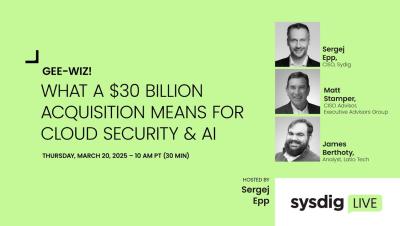
Gee-Wiz! What a $30B Acquisition Means for Cloud Security and AI

The cloud security landscape changed overnight. With Google’s $30B+ acquisition of Wiz, CISOs, security leaders, and multi-cloud teams are left asking: �������� �������������� ��������? What does this acquisition mean for you? How does it impact the pace of innovation, cloud partnerships, and security stacks? What is the future of cloud security, the impact of AI, and where the industry is headed?

Understanding Kubernetes Cluster Architecture: Master & Worker Nodes Explained

Kubernetes has evolved into the industry standard for orchestrating containerized applications. In this article, we break down the architecture of a Kubernetes cluster using practical examples, and code snippets. Whether you’re a beginner or an experienced engineer, you’ll gain clarity on the roles of control plane (historically “master”) and worker nodes, the nuances of multi-control-plane deployments, and updated OpenShift configurations.