Security | Threat Detection | Cyberattacks | DevSecOps | Compliance

Cyber Security for Lawyers: A Practical Compliance Guide

You're in the middle of a normal week, and a partner calls because a client can't open a shared matter folder. Then the help desk finds encrypted files, a strange login from overnight, and an inbox rule that forwarded privileged emails outside the firm. That's the starting point for cyber security for lawyers, not a policy memo, and it's why your firm needs controls that protect confidentiality, preserve evidence, and prove due care when the pressure is on.

A Hands-On Look at Photogenerator.ai: What Happened When I Tested This AI Photo Generator

I needed product shots and headshots fast. No studio. No budget for a photographer. So I opened Photogenerator.ai and spent several sessions testing it as an everyday user. This is what the experience actually felt like. No polished claims. Just notes from the process.

VSS Malaysia and Employment Contracts in Malaysia: A Practical Legal Guide

Employment relationships in Malaysia are generally built around an employment contract, which sets out the terms and conditions governing the relationship between an employer and an employee. Salary, working hours, leave, benefits, duties, confidentiality, termination and other important matters are commonly addressed in the employment contract.

Your Invoice Fraud Controls Probably Never Look at the Signature

Business email compromise took $3 billion in reported losses during 2025, the second-largest category in the FBI's Internet Crime Complaint Center annual report after investment fraud. The same report logged 1,008,597 complaints and $20.877 billion in total losses, up 26% on the year before. The control most organisations built in response is a callback procedure. Payment details changed? Phone the supplier on a number you already had. That control works, and it's worth having.

How Security Awareness Training Safeguards Operations

In any organisation, your people are your most valuable asset, but they can also be your greatest security vulnerability. Technical safeguards like firewalls and antivirus software are essential, but they can't stop a well-meaning employee from clicking a malicious link or unintentionally exposing sensitive data. This is where security awareness training becomes critical. It's not just about ticking a compliance box; it's about transforming your entire team into a proactive and vigilant line of defence that safeguards your daily operations.

The Top 5 Exposure Assessment Platforms (EAP) in 2026

An Exposure Assessment Platform (EAP) discovers assets, identifies exposures such as vulnerabilities and misconfigurations, prioritizes them with threat and business context, and helps drive remediation. Gartner formalized EAPs as a distinct market in November 2025, and the category has quickly become the technology backbone of Continuous Threat Exposure Management (CTEM) programs.

AI Is Accelerating Vulnerability Discovery. Tanium Helps You Keep Up.

Following the Mythos announcement in April 2026, organizations using AI to identify software vulnerabilities have contributed to a significant rise in newly discovered CVEs and CVE definitions. This shift reflects a broader trend across the industry: AI is helping uncover vulnerabilities faster than ever before — and security teams need the visibility, control, and speed to respond. At Tanium, we've been tracking this trend closely across customer environments.

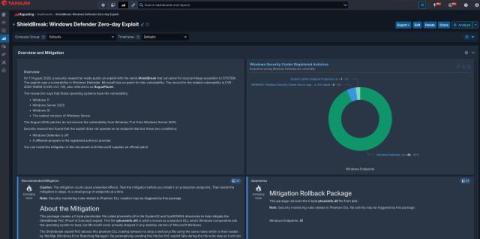
ShieldBreak: The Windows Defender 0-Day with No Patch - And What to Do About It.

In mid-June 2026, Microsoft acknowledged RoguePlanet, a privilege-escalation flaw in the Microsoft Malware Protection Engine (mpengine.dll), the scanning engine behind Windows Defender. Microsoft rated it "Exploitation More Likely" on its Exploitability Index and assigned a CVSS score of 7.8. Microsoft shipped a fix in Malware Protection Engine version 1.1.26060.3008 during its July 2026 patch cycle.

How to Prevent RBAC Role Explosion with Nested Access Lists

In RBAC (Role-based Access Control), a role is a defined object with explicit permissions attached to it. Because roles are designed to be fixed, changing what a particular role can do (for example, in a one-off situation where other permissions are needed for the role) requires editing the role itself. However, repeatedly editing roles makes them less flexible and re-usable, and ultimately complicates access strategies as organizations scale.