Simplifying Global Connectivity: How 11:11 Circuit Management Transforms IT Operations

Managing global connectivity is a lot like trying to assemble a puzzle, where the pieces come from different manufacturers, each with its own shapes, colors, and instructions. You might eventually fit them together, but not without significant time, effort, and potential gaps. For IT teams tasked with navigating the complexities of global connectivity, these obstacles can slow progress and create inefficiencies that ripple across an organization.

Microsoft 365 DLP: what it covers and where it falls short

Microsoft 365 DLP delivers real protection for regulated data in Exchange, SharePoint, Teams, and managed Windows endpoints, but only within that boundary. On-premises file servers, Linux endpoints, unmanaged devices, and non-Microsoft SaaS fall outside enforcement regardless of how policies are configured. Most security teams can't yet clearly distinguish the gaps that configuration fixes can address from those that require supplemental controls.

Reducing Time-to-Protect with Cato's Self-Evolving Vulnerability Protection Agent

TL;DR: In the age of frontier AI models, vulnerability discovery and exploit development are scaling faster than human defenders can manually respond. Security teams already face growing CVE volumes, shorter exploitation windows, and manual workflows for researching vulnerabilities, creating protections, validating them, and preparing them for deployment. As attackers weaponize vulnerabilities faster than organizations can patch them, time-to-protect is becoming a critical security metric.

CrowdStrike Scales AI-Native Agents Across Falcon Exposure Management with NVIDIA

Security teams face a new imperative: act fast, or risk losing the vulnerability battle. The average enterprise faces thousands of vulnerabilities across a sprawling hybrid attack surface. Adversaries are using AI to discover and exploit weaknesses independently, at machine speed, making traditional disclosure timelines increasingly irrelevant. Scan-and-ticket workflows weren't built for this reality, and neither are the teams asked to execute them with finite headcount and growing board-level scrutiny.

Why Your Detection Latency Budget Determines Blast Radius

Most teams buy detection on a single number. The datasheet says “millisecond detection,” the proof-of-concept fires the instant a test payload lands, and the box gets checked. Then a real AI agent incident runs in production, and the postmortem shows the attack completed its objective well before anyone contained it, even though the alert, technically, fired in milliseconds. The number was real. It just measured the wrong thing.

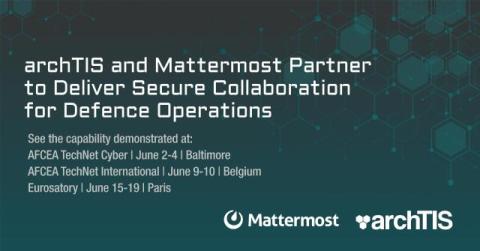
archTIS and Mattermost Partner to Deliver Secure Collaboration for Defence Operations

archTIS and Mattermost are pleased to announce a collaboration to deliver policy-enforced, data-centric security to secure operational collaboration for Defence Ministries, NATO Allies, and coalition partners worldwide. The collaboration combines Mattermost’s secure, mission-critical command-and-control surface with archTIS Trusted Data Integration (TDI) platform, to enable secure collaboration using dynamic policy orchestration via Attribute-Based Access Control (ABAC).

What to Log for AI Agent Activity: The Minimum Viable Audit Trail

The first time a security team needs an AI agent audit trail is usually 72 hours after the agent has already done something it shouldn’t have. Detection fires. Someone pulls every relevant log from the SIEM (Kubernetes audit, container runtime, cloud audit) and three hours in realizes the events that actually matter were never written. Which prompt triggered the tool call. Which parameters the agent passed. Which output left the cluster.

PII protection: 8-step framework from discovery to security

Most organizations can't answer three basic auditor questions simultaneously: where PII lives, who can access it, and how it's protected. One-off scans and manual classification go stale as data volumes grow. A repeatable, eight-step PII protection program from initial discovery through ongoing governance is what separates a defensible compliance posture from a snapshot that collapses under scrutiny.