Runtime-Informed Posture: What AI Agents Can Do vs What They Actually Do

A platform engineer pulls the AI-SPM dashboard for an agent that has been running in production six weeks. The static dashboard shows several dozen findings, severity-sorted by configuration weight. The runtime-informed dashboard shows a smaller, prioritized list — but a few of those findings do not appear on the static view at all, and most of the static findings appear demoted to a tier the static view does not have. Same agent. Same window. Same underlying configuration.

[Webinar] How to Detect Privileged Access Misuse Early | Syteca

Privileged accounts are one of the most common attack paths, yet misuse often goes unnoticed until serious damage is done. As identity becomes the new security perimeter, cybersecurity leaders face a growing challenge: privileged misuse often looks like normal administrative activity until real damage has already occurred. Watch this webinar to explore how organizations can move beyond traditional privileged access management and build an effective early detection strategy for privilege-based threats.

When your most powerful users aren't human: Managing AI and NHIs for compliant privileged access

The identities of the most powerful users and admins in many organizations aren’t people. They’re Non-Human Identities (NHIs). Some of these NHIs execute actions with human configuration and oversight. Others, namely AI agents, can execute high-risk functions at different levels of autonomy. They can perform tasks that range from analyzing data to deploying code, at a volume and velocity far beyond human capabilities.

Cyber Essentials Changes April 2026 (Danzell) - What UK Organisations Need To Know For Certification Success

IASME has come up with a newer version of the Cyber Essentials scheme, introducing significant changes to Cyber Essentials from April 2026. These updates are designed to address evolving cyber threats and ensure the scheme remains robust and relevant. This article addresses the changes you must know, timelines, preparations required, and how you can start this process proactively.

What Is a Fully Managed IT Solution?

A fully managed IT solution is a service model in which a third-party Managed Service Provider (MSP) takes complete ownership of an organization's entire IT environment, covering infrastructure management, cybersecurity, cloud services, help desk support, network monitoring, data backup, and strategic IT planning, all under a single predictable monthly contract. The provider proactively monitors, maintains, and secures your systems around the clock, resolving issues before they impact business operations.

What Is AI-SPM? AI Security Posture Management Explained

Every cloud security vendor launched an AI-SPM dashboard in the past year. Strip away the branding and most of them are presenting the same concept: a new posture management layer for AI workloads. Sit through four demos in the same week and a practical question surfaces. The dashboards look broadly similar — pie charts of findings, compliance tags, a list of AI assets, a severity ranking. Why, then, do the tools underneath cover completely different parts of the problem?

It's time to treat browser extensions like supply chain attack vectors

You would never install an application that can log into your Google docs, read your keystrokes in your browser, intercepts requests in transit, runs continuously, updates silently, AND could be powerful enough to steal your passwords, right? Well, this is more or less what browser extensions can do, and they create vulnerabilities that extend beyond one computer and or even one company.

Release 875: New Mac Features, Enhanced Monitoring, and Granular Data Mapping

This release delivers heavy-hitting updates to the Mac Agent, extends Windows monitoring into native desktop applications like WhatsApp, and provides administrators with more granular tools to manage data and triage security alerts. Here is a summary of the new features and improvements available in this release.

DNS anomaly detection with machine learning: How ManageEngine DDI Central stops threats before they start

Most breaches don't announce themselves; they whisper. A subtly malformed DNS query here. A DHCP lease request that looks almost normal there. A client that suddenly requests a domain no one in your organization has ever heard of. By the time these whispers become alarms on a SIEM dashboard, attackers have often already moved laterally, exfiltrated data, or cemented persistence. In traditional DNS, DHCP, and IPAM (DDI) setups, these signals are buried under millions of legitimate transactions.

How to Detect Phishing Before It Happens: Moving Beyond User Awareness

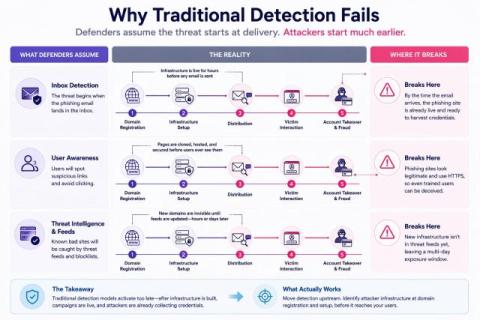
By the time a phishing email lands in an inbox, the attacker’s infrastructure has already been live for hours. That’s not a hypothetical. Zimperium’s 2024 research found that 60% of newly created phishing domains receive a TLS certificate within the first two hours of registration. The site is credentialed, hosted, and ready before most security teams have any signal it exists.