Security | Threat Detection | Cyberattacks | DevSecOps | Compliance

Splunking Isovalent Data: Attack Simulations and Detections

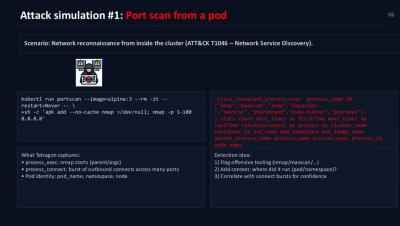
We simulate real-world adversary behaviors inside a Kubernetes cluster to validate how Tetragon’s kernel-level visibility translates into detectable, high-fidelity security signals in Splunk. Each simulation maps to techniques in the MITRE ATT&CK for Containers framework and showcases how eBPF instrumentation allows us to catch what traditional agents often miss—for example, process lineage, syscall context, and Kubernetes workload-level attribution.

Forescout VistaroAI: Security Like You've Never Experienced Before

Cybersecurity moves fast and your environment moves even faster. Forescout VistaroAI helps security teams keep up by instantly analyzing changes across your network and surfacing the risks that matter most. Instead of drowning in dashboards and alerts, Forescout VistaroAI gives you: VistaroAI turns continuous change into clear, actionable intelligence, helping teams stay ahead of threats with confidence.

Claude Code Security: Why Cyber Investors are Panicking

Artificial intelligence, cybersecurity, Claude Code Security, AI security tools and cybersecurity stocks are dominating headlines, but is AI really replacing security professionals? In this Razorwire Raw episode, Jim breaks down the market panic following Anthropic’s Claude Code Security launch, why cybersecurity investors reacted so strongly and what AI can actually do today versus industry hype.

Detect OPERATOR PANDA at the Edge with Falcon Adversary Overwatch

CrowdStrike Falcon Adversary Overwatch: ► Detect adversaries hiding in your blind spots. Falcon Adversary Overwatch exposes threats targeting network edge devices—firewalls, routers, and infrastructure traditional security tools can’t see. Watch the demo to see how CrowdStrike detects OPERATOR PANDA in real time and stops edge-driven intrusions that quickly turn into credential theft and identity abuse before they escalate.

React2Shell (CVSS 10.0): Patch React & Next.js NOW | Unauth RCE Explained

A maximum-severity vulnerability is hitting React Server Components - and if you're running Next.js, you may be vulnerable by default. React disclosed CVE-2025-55182, nicknamed React2Shell, an unauthenticated remote code execution (CVSS 10.0) affecting React Server Components via the Flight protocol. Next.js tracks downstream exposure as CVE-2025-66478: That means internet-wide scanning is likely. Who’s affected?