Security | Threat Detection | Cyberattacks | DevSecOps | Compliance

Identity Lifecycle Management: Process, Stages, Benefits, and Best Practices

Identity lifecycle management is the process of managing a user's digital identity and access from the day they join an organization to the day they leave. It covers account creation, role changes, permission updates, and deprovisioning, and it applies to employees, contractors, service accounts, and increasingly, AI agents. Get it wrong, and you end up with two failure modes: new hires waiting days for access, and former employees who still have it. Both cost money. Only one of them makes headlines.


Just-in-Time Provisioning vs. Just-in-Time Privilege: What's the Difference?

Just-in-Time Provisioning and Just-in-Time Privilege sound almost identical, but they solve different identity management challenges. Let’s say a new software engineer joins your team. They need access to Slack, Jira, GitHub, and other essential apps. Instead of having an IT admin create their account manually, the application creates the account when the employee signs in through your Identity Provider (IdP). That is JIT provisioning.

From Triage to Full Coverage: The Shift AI Agent Security Took in August

Security teams evaluating an AI agent security platform tend to ask the same question after the first demo: will this keep up? Agentic AI changes shape every few weeks, with new frameworks, new coding agents, and new ways for an agent to reach a tool or a credential. A platform that covers today's stack and stalls on next quarter's isn't much of a bet.

When One AI Model Fails Many Companies at Once

Cyber insurance works because losses across a book are mostly independent. One insured suffering ransomware tells you little about the next, so a portfolio of many policies is more predictable than any single one. ‍ Shared AI dependencies break that assumption in a specific way. Where a large share of a book depends on the same foundation model or the same inference infrastructure, a single failure produces simultaneous claims across insureds with no commercial relationship to each other.

Online Gambling Fraud: How Fake Sites, Apps and Social Ads Divert Player Deposits

Online gambling fraud includes more than bonus abuse, payment fraud, account takeover and suspicious withdrawals on a genuine betting platform. Fake gambling sites, cloned apps and deceptive social ads can capture players before they reach that platform, diverting registrations, credentials and deposits into an attacker-controlled or unlicensed environment.

When scanners miss the attack: how Cloudflare Client-Side Security protects storefronts

A modern storefront can look perfectly healthy while malicious JavaScript works underneath: siphoning affiliate revenue, hijacking searches and clicks, tampering with analytics, or asking a remote server what to execute next. Pages load, products appear, and checkout works — yet the browser may be quietly doing something the site owner never authorized. That is the blind spot our Client-Side Security machine learning (ML) model is built to expose.

Top 7 API Security Tools for Banks and Fintechs in 2026

Every digital banking transaction today, whether it’s a fund transfer, a loan approval, or a balance check through a fintech app, runs through an API. API security for banking means protecting these connections from attacks that go far beyond simple hacking attempts: fraud rings probing for account access, bots automating fake transfers, and partners quietly overstepping the access they were given.

Four gaps IRM was never built to close

A buyer’s checklist for the IRM gaps a ServiceNow program leaves open. Many teams deploy IRM, watch the assessments come back clean quarter after quarter, and reasonably conclude they are covered. Months later, the greatest risk turns out to have been outside the sample. It may have changed the week after the review, or lived in a control type nobody tested, or lacked context or prioritization to see its importance.

From Encrypted Mobile Traffic to Payment Manipulation

How KomodoSec’s AigentX Penetration Tester reverse engineered client-side encryption, turned the bypass into reusable Burp tooling, and used that access to validate a real business-logic flaw in a production mobile application. Client-side secrecy failed. Server-side trust became the real vulnerability. THE CHALLENGE A mobile app with TLS, certificate pinning, and a second encryption layer.

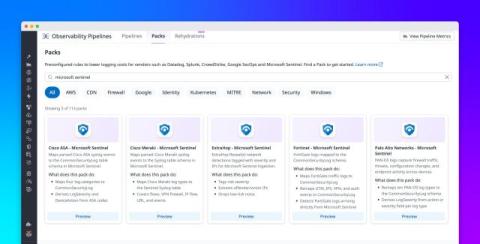
Transform and route security logs to Microsoft Sentinel tables using Observability Pipelines

Microsoft Sentinel is Microsoft’s cloud-native SIEM for detecting, investigating, and responding to threats across your environment. To query security data and run analytics rules, Sentinel expects telemetry data in specific table schemas. But firewall, VPN, and network detection logs arrive in vendor-specific formats, making source-specific mappings difficult to maintain as environments grow.