Security | Threat Detection | Cyberattacks | DevSecOps | Compliance

What OpenTelemetry Can Actually Tell You About Your AI Agents

‍ The distance between what OpenTelemetry was built for and what AI governance is asking of it shows up in a single number. Distributed tracing descends from Dapper, the 2010 Google paper that gave the industry the vocabulary of traces and spans. Dapper sampled one trace in 1,024. That is ample for finding a latency regression, because a regression recurs and the next sample catches it.

Continuous risk monitoring in third-party risk management is non-negotiable: Here's why

Accelerating security solutions for small businesses‍ Tagore offers strategic services to small businesses. A partnership that can scale‍ Tagore prioritized finding a managed compliance partner with an established product, dedicated support team, and rapid release rate. Standing out from competitors‍ Tagore's partnership with Vanta enhances its strategic focus and deepens client value, creating differentiation in a competitive market.

The Hidden Cost of BOLA/BFLA Vulnerabilities: A CISO's Guide to Quantifying Risk

Every CISO managing an API estate has heard of Broken Object Level Authorization (BOLA) and Broken Function Level Authorization (BFLA). What is harder to pin down is what these vulnerabilities actually cost the business when they go unaddressed. Board members and finance teams want numbers, not acronyms, and that gap between technical risk and financial risk is where security budgets get lost. BOLA has held the number one spot in the OWASP API Security Top 10 since the list was created in 2019.

How Aikido finds more vulnerabilities than Claude Security at half the cost

Claude Mythos is arguably the strongest cybersecurity model that Anthropic has built. But we know that model capability is only part of what determines how well an AI vulnerability product performs. To test that, we put Anthropic’s Claude Security, which runs on Mythos, and Aikido Code Security Audit head-to-head on the exact same target to see which harness can deliver the best coverage and at what cost. Code Security Audit is part of Aikido’s AI Code Analysis suite.

How to assess your cyber maturity

Most organisations have more cybersecurity tools than they realise. However, having those things isn’t the same as being secure. At some point, someone, like a Board member, insurer or regulator, is going to ask you to demonstrate that your security works. Not just that you have policies in place, but you can detect an attack, respond to it and recover from it. When that moment comes, you’ll want to know the answer. That’s what a cyber maturity assessment is designed to find.

Agent Immunization: A New Model for Building Trusted AI Agents

The riskiest thing an AI agent does all day isn’t writing code. It’s shopping. Every few minutes, it reaches out for a package, an AI asset, or a tool, and pulls it in with no real way to check what’s inside. We think the fix is agent immunization: security that lives inside what an agent consumes, builds, and ships, not a wall built around it.

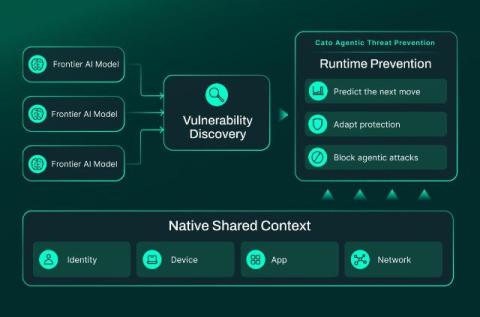
Why Self-Healing Is the Only Way to Secure at Frontier AI Speed

For twenty years, the software security playbook has worked the same way. You find the vulnerability, score it, open a ticket, assign it to a human, wait for the fix, ship the patch, and prove it happened. Every step in that sequence assumes humans can review each fix individually and still keep up. Frontier AI broke that assumption. The exploit window has collapsed from weeks to hours. Attackers reason across your codebase, chain their findings, and ship exploits before a CVE is even published.

Pharma Biotech DLP: Protecting IP, CRO Access, and Compliance

In the pharma and biotech sectors, a single data leak doesn’t just trigger regulatory fines. It can wipe out a decade of R&D, hand patented drug formulations to competitors, and instantly derail a clinical trial. Your most valuable assets no longer live safely inside a single corporate network. They constantly move through a fast-paced ecosystem of remote researchers, external laboratories, and Contract Research Organizations (CROs).

Cato CTRL Insights: When Trust Becomes the Payload in a Fake Codex ClickFix Campaign

Attackers are using a fake Codex download experience to trick macOS users into pasting a malicious command into Terminal. This technique, known as ClickFix, relies on social engineering rather than a conventional malware download: the victim is persuaded to perform the execution step themselves. We analyzed sponsored search results leading to convincing Google Sites pages, a no-code website-building and hosting service provided by Google.