Security | Threat Detection | Cyberattacks | DevSecOps | Compliance

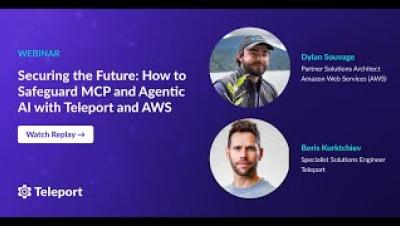
Securing the Future: How to Safeguard MCP and Agentic AI with Teleport and AWS

As enterprises rapidly adopt agentic AI and large language models (LLMs) to automate critical business processes and access sensitive data, the traditional security playbook is no longer sufficient. The Model Context Protocol (MCP), a new connector for AI systems like Amazon Bedrock Agents, is revolutionizing enterprise integration—but it also introduces new risks. Join us for an in-depth session exploring how to secure MCP-based AI architectures using Teleport’s Infrastructure Identity Platform and AWS. We’ll cover.

Weaponizing AI Coding Agents for Malware in the Nx Malicious Package Security Incident

On August 26–27, 2025 (UTC), eight malicious Nx and Nx Powerpack releases were pushed to npm across two version lines and were live for ~5 hours 20 minutes before removal. The attack also impacts the Nx Console VS Code extension.

Why Smart Companies Are Moving to Context-Based AI Security

AI consumes massive volumes of unstructured data — emails, documents, reports, and prompts. Hidden within them are sensitive details: customer PII, salary data, intellectual property, and confidential financial information. Without the right safeguards, one innocent prompt can lead to costly data leaks, compliance violations, and privacy risks. Traditional security tools like RBAC, DLPs, and prompt filters weren’t designed for AI. They fail because AI doesn’t see folders — it consumes raw context. That’s where Protecto’s Context-Based Access Control (CBAC) comes in.

Securing the AI Revolution: Introducing Cloudflare MCP Server Portals

Large Language Models (LLMs) are rapidly evolving from impressive information retrieval tools into active, intelligent agents. The key to unlocking this transformation is the Model Context Protocol (MCP), an open-source standard that allows LLMs to securely connect to and interact with any application — from Slack to Canva, to your own internal databases. This is a massive leap forward.

Best Practices for Securing Generative AI with SASE

As Generative AI revolutionizes businesses everywhere, security and IT leaders find themselves in a tough spot. Executives are mandating speedy adoption of Generative AI tools to drive efficiency and stay abreast of competitors. Meanwhile, IT and Security teams must rapidly develop an AI Security Strategy, even before the organization really understands exactly how it plans to adopt and deploy Generative AI.

AI Agents Complicate GRC

The challenge isn’t just that AI agents are new. It’s that they blur traditional boundaries of data control, creating hidden sub-processors and uncontrolled data flows. For CISOs, compliance officers, and security leaders, this presents a fundamental governance problem: if you don’t know which AI services are touching your data, you cannot prove compliance.