Security | Threat Detection | Cyberattacks | DevSecOps | Compliance

Navigating the EU Data Act: Why orchestration helps

Over the past decade, data has evolved from being an operational byproduct to becoming one of the most valuable assets of any business. The explosion of IoT devices, cloud applications, and AI-driven systems has generated unprecedented volumes of personal and non-personal data. Alongside this growth, regulations in the EU have progressed in step.
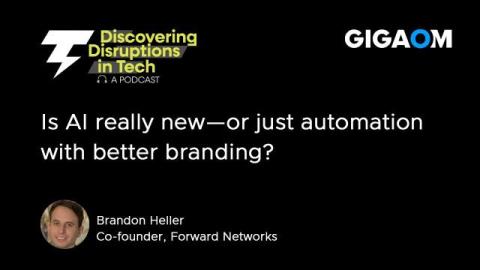
Is AI really new-or just automation with better branding?

“AI is just automation by a different name.” It’s a bold claim—but one that Brandon Heller, CTO and co-founder of Forward Networks, and Howard Holton, CEO of GigaOm, unpack in a way that will make you think. In their recent conversation on Discovering Disruptions in Tech, they make the case that artificial intelligence, especially generative AI, is not delivering brand-new capabilities.

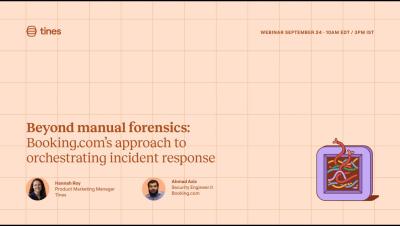
Beyond manual forensics: Booking.com's approach to orchestrating incident response

Browser history can play a critical role in incident response, from helping analysts reconstruct user activity and validating alerts, to uncovering malicious behavior. But retrieving raw artifacts from endpoints is often slow, manual, and inconsistent. In this technical session, Ahmad Aziz, Security Engineer II at Booking.com, will share his winning entry from the 2024 “You Did WHAT?! With Tines” (YDWWT) competition: a fully automated workflow that pulls raw browser history artifacts from devices using CrowdStrike and prepares them for offline forensic analysis.

Why traditional IAM can't keep up, and how orchestration can fix it

Identity touches everything in modern IT. Whether it’s logging into email, provisioning a VM, or accessing a CRM, identity and access management (IAM) is the digital backbone of work. Yet the controls meant to safeguard it haven’t kept up with the scale, speed, and complexity of today’s environments. The cracks show up everywhere.

90 Days to SOC Autonomy: How Torq Customers Get There

Security operations shouldn’t be defined by burnout, backlog, and brittle tools. Torq HyperSOC replaces the slow, manual SOC model with an autonomous system powered by agentic AI, Hyperautomation, and seamless stack integration. In just 90 days with Torq, security teams move from reactive to proactive — automating Tier-1 triage, accelerating response, and freeing analysts to focus on what matters most.

Unleash your innovation with You Did WHAT With Tines?! Fall 2025

It’s fall, the leaves are starting to turn, school is back in session, but that also means our bi-annual workflow competition You Did WHAT With Tines?! (YDWWT) is here for the Fall 2025 season! This competition challenges our community of builders - from customers to partners - to bring forth their most impressive workflows, in the hopes to be recognized among the best of the best.

Orchestrating patch management: faster, safer, simpler

Few security practices carry as much weight as patch management. Consider the cautionary tale of Travelex. In early 2020, the British currency exchange was hit by a ransomware attack that spread quickly across its network, locking staff out of their systems. Reports suggest the company paid millions to restore access and prevent sensitive data from being sold; an outcome that underscores how a single gap in patching can cascade into a business-wide crisis.

Orchestrating AI: The practical way to scale while reducing tool sprawl

Every IT team is under pressure to “do more with AI.” A new tool promises smarter workflows, a new agent claims to replace manual tasks. But if you’re managing service requests, availability SLAs, patch cycles, infrastructure capacity, and application performance every day, you know the truth: AI doesn’t automatically reduce complexity on its own.

Torq for MDRs: Increase Margin and Onboard Customers Faster

Managed detection and response (MDR) providers faceskyrocketing demand and rising stakes. The MDR market is projected to grow to $11.8 billion by 2029 (up from $4.1 billion in 2024), a 23.5% compound annual growth rate driven by the intensifying landscape of advanced threats and sophisticated attacks, as well as ongoing cybersecurity talent shortages.