Security | Threat Detection | Cyberattacks | DevSecOps | Compliance

The AI SOC Analyst That Offloads 90%+ of Tier-1 Cases - Meet Socrates

Security Operations Centers (SOCs) continue to struggle in 2025. The perfect storm of growing alert volume, consistent talent shortage, and the well-documented limitations of legacy SOAR solutions have brought many SOC teams to a breaking point. At the same time, bad actors continue to innovate, and cybercriminals have become more sophisticated in their tactics and techniques, including using AI to launch attacks at scale.

The Multi-Agent System: A New Era for SecOps

Security teams face mounting pressure to defend against sophisticated cyber threats. Traditional automation strategies are often rigid, reactive, and lack the ability to scale effectively. Many SOCs already have access to generative AI to assist with simple tasks and now Torq has brought agentic AI into the mix — which thinks, acts, and learns autonomously to handle security risks. What’s next?

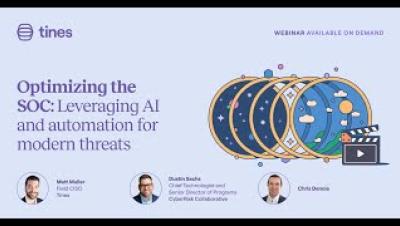
Tines' Field CISO Matt Muller on security's communications problem and the future of the SOC

In this week’s episode of The Future of Security Operations podcast, I'm joined by Matt Muller, Field CISO here at Tines. With over a decade of experience at companies like Material Security, Coinbase, and Inflection, Matt’s got a strong track record of scaling SecOps teams, building threat detection and mitigation programs, and driving trust and safety initiatives. His knowledge impressed the Tines team so much that we invited him to join the team as our first Field CISO. Matt and I discuss.

Tines 101

Join Danielle, Product Engagement Manager, and Sif, Solutions Engineer, in a demo of the Tines platform. This session highlights Alex, an IT administrator, who discovers Tines as a solution to his repetitive tasks by building a workflow that processes data from Workday to create user accounts in Okta. New to Tines? Sign up for our always-free Community Edition and start building right away.

Tines' Field CISO Matt Muller on security's communications problem and the future of the SOC

In this week’s episode of The Future of Security Operations podcast, Thomas is joined by Matt Muller, Field CISO at Tines. With over a decade of experience at companies like Material Security, Coinbase, and Inflection, Matt’s got a strong track record of scaling SecOps teams, building threat detection and mitigation programs, and driving trust and safety initiatives. His knowledge impressed Thomas and the Tines team so much that they invited him to become the company's first Field CISO.

The buyer's guide to automated compliance for startups

Getting your first SOC 2 or ISO 27001 certification and building your security program used to be a painfully slow and manual process. But thanks to automation, the path to compliance has gotten a lot faster and simpler, lowering the barrier to entry for security-minded startups that want to build and demonstrate trust with customers early on.

Three SOC Threats Solved in Minutes with Torq Hyperautomation

Your SOC exists for one core reason: to rapidly reduce the mean time to detect, investigate, and respond to threats. The more efficiently your team operates, the faster you reduce essential KPIs like MTTR, MTTD, MTTI, and what we call ‘MTTx’ (mean time to anything). Ask our Field CISO, Patrick Orzechowski (PO), and he’ll tell you straight: If your SOC isn’t relentlessly focused on reducing risk through speed, you’re falling behind. Talking about efficiency is easy.