
Security | Threat Detection | Cyberattacks | DevSecOps | Compliance

Continuous Compliance Monitoring: A Practical Guide

83% of organizations reported moderate or major delays from manual compliance work in 2026, while 53% said one full-time employee's worth of effort is spent on evidence collection, according to the 2026 State of Continuous Compliance Monitoring report. Those figures describe the operational problem more accurately than another promise of an audit-ready dashboard.

Agentic AI Security: Credentials and Permissions Define the Blast Radius

In July 2026, researchers at Noma Labs coaxed GitHub's new Agentic Workflows into leaking data from a private repository. It wasn’t from malware. They created a plausible-looking issue in a public repository containing instructions for the agent to retrieve information from other repositories in the organization. After testing variations of the prompt, they found that adding one word, "Additionally," was enough to get past GitHub's guardrails.

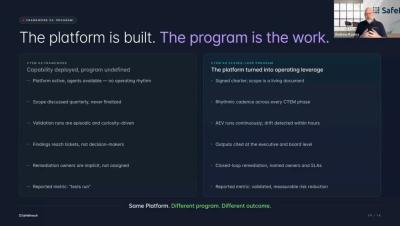
How Do You Operationalize CTEM and Prove It's Working?

Having the right security platform is only part of the equation. Two organizations can have similar security stacks and still achieve very different outcomes depending on how they operationalize their Continuous Threat Exposure Management (CTEM) program. In this video, learn what separates reactive, ad hoc security validation from a mature CTEM program—including: See how a structured CTEM program can turn continuous security validation into measurable progress across your organization.

What makes a good AI coworker? With OpenAI's Codex product lead

Zero-Shot Learning is a podcast about how AI is built, secured, and deployed. Hosted by Nancy Wang, 1Password CTO, and Dev Tagare, Senior Director of Engineering at Google Gemini, it offers a builder’s view of the architecture and complex decisions involved in shipping AI.

Left Unsupervised: 10 Times Access Outlived Its Authorization

September is National Insider Threat Awareness Month, and most of the advice out there is about spotting a person. The insider here is rarely a person. It’s a credential nobody rotated, or an agent nobody kept watching. Each was access granted on purpose, then left unmonitored. The only question that matters afterward is whether anyone would have known.

How to Use AI to Turn Images into Engaging Video Content

Video has become one of the most effective ways to communicate online. From social media posts to product promotions, businesses and creators increasingly rely on video to capture attention and reach wider audiences. However, producing video content can take significant time and resources. Writing scripts, recording footage, editing clips, and adding effects can quickly turn a simple idea into a lengthy production process.

How a Solo Garden Designer Cut Concept Time in Half with AI Tools

I used to spend entire evenings sketching rough layouts for clients who just wanted "something prettier than the current yard." By the time I produced three decent options, the client had already moved on or decided the project could wait. That cycle was exhausting and expensive for both of us.

The Discrepancy Between the Results of Compliant Penetration Tests and What Really Defines an Organization's True Attack Surface

Organizations are investing large sums of money and resources in obtaining ISO 27001 certifications, SOC 2 attestations and performing yearly penetration tests, yet six months after the fact they hear about a breach involving one of their organizations in the media. This trend is so common, that many incident response professionals have used this as a recurring example when conducting post-breach analysis.

The Financial Imperative of Garage Door Security in Long Island

To effectively break-in proof a smart garage door in Long Island, homeowners must combine structural reinforcements with advanced digital encryption. The definitive strategy requires upgrading to a solid insulated steel or wood door, integrating a smart opener equipped with military-grade rolling code technology, applying opaque films to visible windows, deploying motion-activated surveillance cameras, and physically securing the emergency release mechanism. These comprehensive measures successfully neutralize both brute-force physical entry tactics and sophisticated radio-frequency signal hacking.