How to Implement Network Policy in Google GKE to Secure Your Cluster

By default, pods are non-isolated; they accept traffic from any source. The Google GKE solution to this security concern is Network Security Policy that lets developers control network access to their services. Google GKE comes configured with Network Security Policy using Project Calico which can be used to secure your clusters. This class will describe a few use cases for network security policy and a live demo implementing each use case.

FINRA: Phishing Emails Targeting Financial Companies

On Monday, May 4th, **FINRA (Financial Industry Regulatory Authority), issued a warning to financial companies stating that a new email phishing campaign was doing the rounds. According to the regulator, the campaign is ongoing, widespread, and made to look as though the emails are coming from FINRA itself.

Getting up and running with Calico Host Micro segmentation Protection on AWS

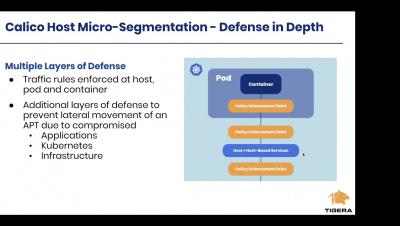
In this online training, we will explain how to install and configure Calico on a vm/host to apply network policy to resources outside your K8s cluster. The talk will be primarily a walkthrough and demo and you will receive all manifests and instructions to do the demo on your own after the session.

Security And Compliance for Remote Federal Workers

With much of the federal workforce now using laptops to work from home, how can agencies like yours overcome VPN hurdles and ensure the same standard of security monitoring? Compliance frameworks help you achieve and maintain remote asset security with detailed, step-by-step guidance on best practices, including extending security controls to cover remote laptops and other endpoints employees may be using from home in the wake of Covid-19.

What is Attack Surface Management?

Attack surface management (ASM) is the continuous discovery, inventory, classification, prioritization, and security monitoring of external digital assets that contain, transmit, or process sensitive data. In short, it is everything outside of the firewall that attackers can and will discover as they research the threat landscape for vulnerable organizations.

Security configurations-Part one: 7 reasons why security configurations are crucial to your security blueprint

Security configurations are security-specific settings used to secure heterogeneous endpoints such as servers, desktops, laptops, mobile devices, and tablets. As endpoints in your network diversify, securing each endpoint becomes a challenge. One way to ensure effective endpoint security is by automating it, which is where security configurations come into play. Security configurations are utilized to secure and control every facet of your network.

Balancing security and flexibility with a remote workforce

According to the Pew Research Center, last year, roughly seven percent of U.S. workers regularly enjoyed the option of working from home. Well accustomed to the nature of remote work, these individuals were equipped with stable internet connections, collaboration and communication tools, and security technologies that helped them excel from their home offices.

Detectify security updates for 29 April

For continuous coverage, we push out major Detectify security updates every two weeks, keeping our tool up-to-date with new findings, features and improvements sourced from our security researchers and Crowdsource ethical hacker community. Due to confidentially agreements, we cannot publicize all security update releases here but they are immediately added to our scanner and available to all users. This post highlights a few things that we have improved in the last two weeks.

The MITRE ATT&CK Framework: Discovery

The Discovery tactic is one which is difficult to defend against. It has a lot of similarities to the Reconnaissance stage of the Lockheed Martin Cyber Kill Chain. There are certain aspects of an organization which need to be exposed in order to operate a business. What is the MITRE ATT&CK™ Framework? - YouTube An error occurred. Try watching this video on www.youtube.com, or enable JavaScript if it is disabled in your browser.

Uncovering Bots in eCommerce Part Two: Loyalty Points

Loyalty schemes operated by the eCommerce industry have become so popular that they now represent a billion-dollar industry, with customers earning loyalty points when purchasing goods or services from their favourite brands. Yet financial losses from loyalty card fraud are equally significant — with an estimated $1 billion being stolen every year.