Securing the web (forward)

We have grown to expect a reasonable level of privacy and security when we use services on the web and web-based applications. That’s because these services deal with every aspect of our daily lives — from money and finances, to how we interact with government services, to our education or the education of our children, to communicating with friends and family, to healthcare, to simply buying food to eat.
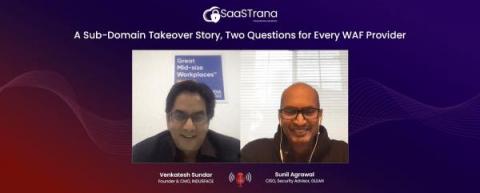

A Sub-Domain Takeover Story, Two Questions for Every WAF Provider | Sunil Agrawal (CISO, Glean)

In this SaaSTrana podcast, Sunil Agrawal (CISO, Glean) shared his insights with Venky on the evolution of cybersecurity attacks and changes in hacker behavior over the years. He also shares his experience of a sub-domain takeover and how it led him to build foundationally secured SaaS products.

WatchGuard Earns 7th Consecutive 5-Star Rating in CRN's 2023 Partner Program Guide

CRN has once again honored WatchGuard with a prestigious 5-star rating in its 2023 Partner Program Guide! This recognition marks the 7th consecutive year that the WatchGuardONE partner program has earned top marks in CRN’s definitive directory of the most rewarding partner programs for the IT channel. The 5-star rating of CRN’s annual Partner Program Guide is awarded to companies that go above and beyond to nurture strong, profitable, successful channel partnerships.

Just-In-Time Privilege Elevation: A least-privilege solution to protect your AD-connected business

One Identity Just-In-Time Privilege automatically assigns privileges at the time of a credential check-out – and immediately removes privileged access and resets the account password when task is completed. This protects your Active Directory from bad actors and potential breach.

Bank Account Verification: The Benefits of Using Bank Account Verification APIs

When a consumer opens a bank account, the bank goes through a procedure called bank account verification. It enables all required checks to be made on the account user and the source of their income, successfully stopping illegal activities like money laundering and the financing of terrorism. In this post, we’ll examine how to validate a bank account and its owner, as well as the legal considerations that must be made while validating a client’s bank account.

What are Cyber Security False Positives & How To Prevent Them

Imagine you've alerted your IT team to a critical infrastructure error plaguing your network. You ask them to drop their current work and focus on immediate remediation of this detected vulnerability. After further investigation, however, it is found to be a false positive. Unfortunately, these incidents are commonplace – and they cost your organization valuable time and manpower. More worrying, they distract from legitimate security issues.

Securing API Keys: A Guide for Analysts and Engineers

API keys are unique identifiers that enable developers to access and interact with an application's data and services. They act as a bridge between applications, allowing them to share data and functionality. In today's digital world, API keys are increasingly important as they facilitate seamless communication between various applications and services.

Tofsee Botnet: Proxying and Mining

In January 2023, PrivateLoader, a malware loader from a pay-per-install malware distribution service called “ruzki”, started to distribute Tofsee (a.k.a. Gheg), a modular spambot. Spambots are typically utilized by cybercriminals to spread malware and phishing emails, and this particular one has been in operation since at least 2008.

SEBI's Regulations on E-Wallet KYC: What You Need to Know

Banks and fintech have been ordered by SEBI to ensure that investors complete transactions for mutual funds using e-wallets that comply with KYC requirements. The start date for this is May 1, 2023. The most recent SEBI circular suggested that all e-wallets fully comply with the RBI’s KYC requirements. In 2017, SEBI gave permission for fund firms to utilise e-wallets to collect up to Rs. 50,000 each fiscal year.

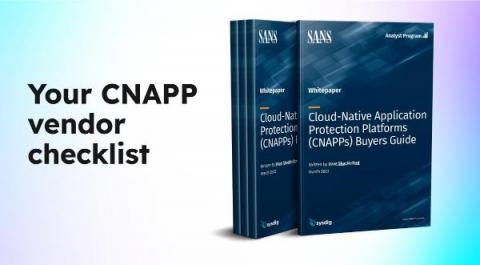
SANS Cloud-Native Application Protection Platforms (CNAPP) Buyers Guide

The SANS Cloud-Native Application Protection Platforms (CNAPPs) Buyers Guide gives companies a deep dive into what to look for in a CNAPP solution. As organizations continue to shift towards integrated platform-based solutions for their cloud security needs, it becomes critical to evaluate whether a CNAPP solution meets all the requirements across use cases like posture management, permissions management, vulnerability management, and threat detection and response.