Beyond the Hype: What True API Security Leadership Looks Like

In our previous post, we highlighted a key insight from the 2025 KuppingerCole Leadership Compass: securing AI depends on securing APIs first. The report emphasizes that as AI use grows, the attack surface for APIs becomes more complex and risky. With many solutions available, navigating vendor claims can be challenging, making independent expert analysis extremely valuable.

What You Need to Know about the PayPal Data Breach

PayPal was established in 1998 by Peter Thiel, Luke Nosek, and Max Levchin. The application's goal was cybersecurity for handheld devices before pivoting to a digital wallet. It merged with X.com in 2000 and was later rebranded for online payment systems. After spinning off from eBay in 2015, the platform expanded globally to democratize financial services to ensure everyone can access convenient products.

Declutter your crypto: Machine identity security for a post-quantum world

In a bad dream, you open the closet. You think you know exactly what’s in there: a few SSH keys, a bunch of TLS certificates, and some secrets like API keys locked in what you believe to be a safe place. But pull it all out and suddenly you find yourself face-to-face with stacks of forgotten ciphers, drawers stuffed with expired certificates, and algorithms in use you thought teams had left behind in 2011. And that’s just for one application.

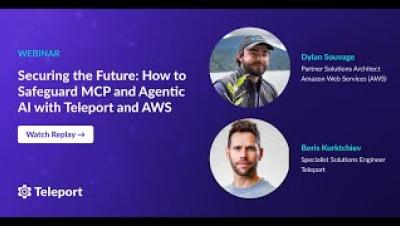
Securing the Future: How to Safeguard MCP and Agentic AI with Teleport and AWS

As enterprises rapidly adopt agentic AI and large language models (LLMs) to automate critical business processes and access sensitive data, the traditional security playbook is no longer sufficient. The Model Context Protocol (MCP), a new connector for AI systems like Amazon Bedrock Agents, is revolutionizing enterprise integration—but it also introduces new risks. Join us for an in-depth session exploring how to secure MCP-based AI architectures using Teleport’s Infrastructure Identity Platform and AWS. We’ll cover.

The Role of AI in Endpoint Security

One can’t discuss the modern state of endpoint security without mentioning a term that has quickly become ubiquitous with security solutions: artificial intelligence (AI). With a constantly evolving threat landscape and many security challenges plaguing organizations (e.g sprawling attack surfaces, monitoring and continuity gaps, alert overload, and limited resources), it’s clear that endpoint security must evolve as well, and the most-promising advancement is AI.

We Are the Weakest Link

The old phrase “we’re only human, after all” is what cyber-adversaries are relying upon to gain access to intellectual property, data, and credentials. Adversaries prey on the humanity in us to read an unsolicited email, act out of a sense of urgency, or succumb to their scare tactics. We are bombarded with social engineering scams daily. Why do some of us fall victim while others see through veiled attempts at getting us to relinquish something of value?

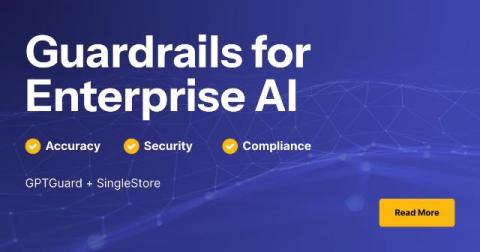
Why Protecto Chose SingleStore as Part of GPTGuard's Architecture

Traditional RAG creates risk. In enterprise AI, accuracy and security aren’t optional. Most vector-only databases are built for speed, but they ignore enterprise realities like security and compliance. Without context, access controls, or accurate recall, they create compliance gaps that make AI unsafe for regulated industries. At Protecto, we built GPTGuard to change that — making enterprise AI safe by preventing data leaks, enforcing privacy, and keeping compliance intact.

Widespread Salesforce Data Theft via Compromised Salesloft Drift OAuth Tokens

On August 20, 2025, Salesloft published an advisory describing a security issue potentially affecting the Salesloft Drift integration with Salesforce. On August 26, Google Threat Intelligence Group (GTIG) provided additional details about the campaign, in which a threat actor known as UNC6395 authenticated against Salesforce customer instances using compromised OAuth tokens tied to the Salesloft Drift integration with Salesforce.