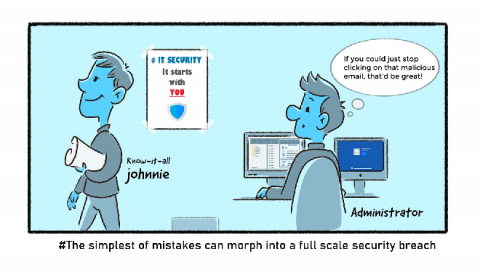
The job of IT admins and IT security analysts are, without a doubt, some of the most important jobs in any company. When things are running smoothly, it is easy for everyone to forget they exist. However, the moment things go askew, everyone points fingers at them. IT security professionals are expected to know everything. Most of them are self-taught and have learned on-the-job. Over time, experience has turned them into battle-hardened soldiers.
We are certainly in unique times, with COVID driving digital transformation at an unprecedented pace, remote work appearing to be long term, and the specter of new threats looming over security professionals as they strategized how to protect a rapidly changing business and tech landscape. To use perhaps one too many cliches: it is the best of times, it is the worst of times, the times are a changin’, and a change will do you good. No really, it will.
Security is not compliance. This is something that the security champions at Detectify can agree on and each employee practices security everyday to help keep our customers and business secure. You’ve probably never met a more engaged group about security training than us at Detectify! We are passionate about our industry and maybe even gain a few new security nerds every few months as we go.
We at Netskope Threat Labs have published a series of blogs detailing the misconfigurations in cloud apps causing data exposure. Misconfiguration and sensitive data exposure have been listed as predominant top 10 OWASP security risks for years, and are now also the predominant cause of cloud data breaches.
Access control is a security technique that regulates who or what can view, use or access a place or other resources. It is a fundamental concept in physical security and information security designed to minimize risk. At a high level, access control is about restricting access to a resource. Any access control system, whether physical or logical, has five main components: Access control can be split into two groups designed to improve physical security or cybersecurity:
It’s been a stressful year, to say the least, for the government and education sector. Government organizations were challenged with pivoting their operations to a digital model while schools were forced to decide between hybrid or remote learning programs for their students. The rise of digital operations has made application security (AppSec) more important than ever.
2020 will always be remembered as the year our lives changed dramatically due to the Coivd-19 pandemic. Here our panel of security experts look back at the lessons learned in the past 12 months and share their predictions for the key security challenges organizations will face in 2021.
There is no shortage of IT cloud software services out there for businesses to choose from. Regardless of their business needs you can be sure there will be a myriad of solutions. Instead of a few grand does-it-all services, IT has become a swarm of inter-playing, inter-operating, and interconnecting services. It’s no surprise that services like zapier and IFTTT are thriving in this ecosystem where they can become the glue and automate the gap between them. The future is surely bright.