Security | Threat Detection | Cyberattacks | DevSecOps | Compliance

7 Things CTO Needs to Consider While Selecting a Cloud Security Solution

A recent survey conducted in 2021, states that approximately 64 percent of respondents listed data leakage or data loss as the most crucial cloud security concern. This makes selecting a cloud security solution an important decision that drives the scalability of the organization. As this may be a tricky business, we have brought to you a few considerations every CTO should take into account while selecting the cloud security solution.

Talking About the CISO Mental Health Crisis

For the past 20 years, I’ve served as CISO for companies across different sectors. In this role, I have shouldered responsibility for protecting each organization from a wide swath of rapidly developing cybersecurity threats. I have also learned firsthand how much stress security leaders face day-to-day. Recent conversations with my peers have shown stress in cybersecurity is an industry-wide problem. The CISO role is one of the most stressful in any organization.

Navigating Change Results - The CISO and CTO View

The Results are In Diverse approaches, but consistent cost savings. Our latest research shows European CIO and CISO intentions and practices at a time of huge security and networking change. See the key findings, dig into the results and hear analysis of what it all means directly from our EMEA CISO Neil Thacker and VP Vice President, Sales Engineering, EMEA/LATAM, Andy Aplin. What does network and security transformation mean in practice for teams, budgets, skills and suppliers? View our video & infographic for the key headlines – then request our Ebook for the full picture.

Cloud Threats Memo: Why Multi-Factor Authentication is a Must-Have

Despite the growing interest in cloud accounts by opportunistic and state-sponsored actors, too many organizations fail to implement basic security measures to protect their cloud apps, such as multi-factor authentication (MFA) for administrators and users. This is the concerning finding of a report recently released by Microsoft, according to which just 22% of Azure Active Directory customers implement strong authentication mechanisms such as MFA or passwordless authentication.

What Are Azure AD Custom Security Attributes?

Microsoft released a valuable new Azure feature in December of 2021: custom security attributes. This feature is still in preview. Custom security attributes enable organizations to define new attributes to meet their needs. These attributes can be used to store information or, more notably, implement access controls with Azure attribute-based access control (ABAC). Azure ABAC, which is also in preview, enables an organization to define access rules based on the value of an object’s attribute.

How to Protect Cloud Workloads from Zero-day Vulnerabilities

Protecting cloud workloads from zero-day vulnerabilities like Log4Shell is a challenge that every organization faces. When a vulnerability is published, organizations can try to identify impacted artifacts through software composition analysis, but even if they’re able to identify all impacted areas, the patching process can be cumbersome and time-consuming. As we saw with Log4Shell, this can become even more complicated when the vulnerability is nearly ubiquitous.

Cloud Threats Memo: New Malicious Campaign Using GitHub for Command and Control

State-sponsored threat actors continue to exploit legitimate cloud services. In their latest campaign, uncovered by Malwarebytes during January 2022, the North Korean group Lazarus (AKA HIDDEN COBRA) has been carrying out spear phishing attacks, delivering a malicious document masquerading as a job opportunity from Lockheed Martin (37% of malware is now delivered via Office documents).

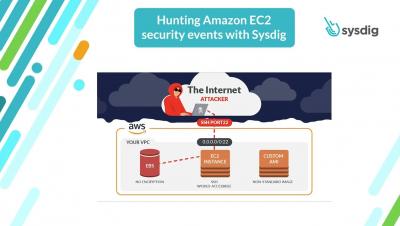
Sysdig Secure - When cloud provider security services are not enough

The benefits of cloud computing are causing the adoption of cloud services by companies of all sizes to increase each year. The reduction of operating costs, time to market, ease of use, and reliability are some of the most significant benefits. However, the shared responsibility model must be taken into consideration. Cloud breaches are already everywhere and it doesn’t look like they’re going to slow down anytime soon.