Security | Threat Detection | Cyberattacks | DevSecOps | Compliance

2025 Data Security Insights and Resources to Prepare for 2026

Data security in 2025 was less about reacting to breaches and more about surviving in a world where data is everywhere, attackers are faster, and trust is fragile. While the core goal of protecting sensitive information hasn’t changed, how organizations approach security has evolved significantly.

How GenAI is Changing Data Security and What Enterprises Must Do

Generative AI (GenAI) is changing data security in today's businesses. It affects both cybersecurity defenses and the types of threats we face. Organizations encounter innovations that boost detection and automate tasks. However, these changes also create new avenues for attack. Security leaders must understand this duality to protect systems and information. This article examines the dual impact of GenAI on enterprise security. We cover the opportunities it creates for defense and the new risks it introduces. Finally, we outline actionable strategies to protect your organization.

Safeguarding Patient Data in Medical Transportation: Closing the Cybersecurity Gaps

Non-emergency medical transportation (NEMT) sits at the intersection of healthcare, logistics and information technology. While the core job seems simple-bring patients to medical appointments and take them home safely-it involves sensitive health data, GPS tracking, scheduling, billing and communication between dispatchers, drivers, facility staff and patients.

AI and Data Security: Why Your Data Security Model Is Hurting Innovation

Why Your Data Security Model Is Outdated For over 20 years, we’ve focused on the Data Envelope—securing the perimeter, the cloud, and the network. But in a world of AI and rapid data sharing, protecting the envelope is not enough. In this video, James Rice (VP of Product Marketing at Protegrity) explains why traditional security has become the biggest bottleneck for modern innovation. Whether you are a security leader, a data architect, or a business innovator, understanding this paradigm shift is essential for the next decade of growth.

How Modern Businesses Are Strengthening Operations While Reducing Security Risks

The line between operational efficiency and cybersecurity has never been thinner. Every system you implement, every process you streamline, and every partner you onboard creates potential vulnerabilities that threat actors are eager to exploit. Yet standing still isn't an option. Businesses must scale, automate, and optimize to remain competitive. The key lies in choosing solutions and strategies that strengthen your security posture while improving operations.

When Customer Data Quietly Walks Out the Door: Lessons from the Coupang Breach

Large data breaches rarely begin with dramatic system failures. More often, they start with sustained, unauthorized access to sensitive data that goes undetected for months. The recent breach at Coupang, South Korea’s largest e-commerce platform, illustrates this pattern clearly. Nearly 34 million customer records were likely exposed over an extended period before detection.

Build a Context-Aware DLP Entity Detector Without Regex (Prompt-Based Detection Demo)

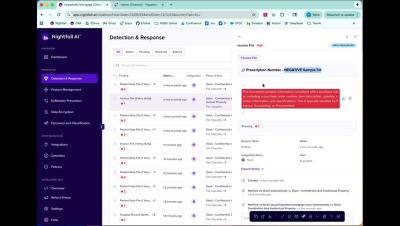
See how to build a prompt-based custom entity detector in Nightfall that understands context, not just patterns. Using a real healthcare example, you’ll see how prescription numbers are detected accurately while similar-looking data like purchase order numbers are ignored. You’ll see: Why regex breaks down in real workflows How prompt-based detection reduces false positives Creating a custom detector with positive and negative examples Deploying it to Slack and validating results across files.

20 Causes of Data Loss Threatening Businesses in 2026

Data is not just a strategic asset. It’s the lifeblood of your organization. Losing access to any strategic asset can threaten an organization’s viability; without plants and equipment, manufacturers would find it difficult to succeed, and service providers can’t operate without brand recognition. Similarly, without data, your organization could be left in a state of complete and utter paralysis, unable to function or recover.

Create Custom File Classifiers with Nightfall AI. No Regex Required

DLP solutions have a challenge in detecting standard document types: financial records, source code, and customer lists. Moreover, what happens when your organization needs to protect business-critical documents that don't fit pre-built categories? Or when you need more granular classification to support specific workflows? Traditional approaches force you to choose between brittle regex patterns that generate false positives.

Create Highly Specific File Classifiers with Nightfall's Prompt-Based AI. No Regex Required

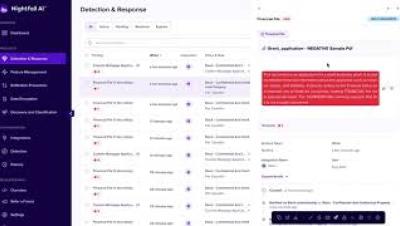
Many sensitive documents don’t fit cleanly into standard categories, and traditional approaches like regex or broad classifiers often create noise and false positives. In this video, we walk through how to use Nightfall’s prompt-based file classifiers to detect business-critical documents based on intent, not brittle patterns or custom model tuning.

AI-Native Browsers Demand AI-Native Security: Why Legacy DLP Can't Protect You

In our recent analysis of AI browser exfiltration risks, we exposed how OpenAI's Atlas and Perplexity's Comet create permanent backdoors to sensitive data through persistent memory, autonomous agents, and cross-platform sync. The challenges with AI native browsers strongly resonated with CISO’s and security leaders we speak with on a daily basis. But the threat extends far beyond Atlas and Comet.

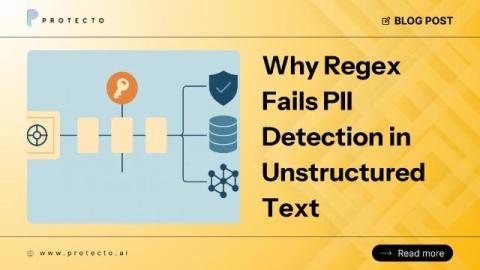
PII Detection in Unstructured Text: Why Regex Fails (And What Works)

Let’s look at something many teams quietly struggle with. Detecting PII inside unstructured text. It feels like it should be simple. After all, we’ve used regular expressions for years to find emails, phone numbers, and ID formats. Yet when we deploy regex in real environments. ticket systems, chat logs, CRM notes, uploaded documents, support transcripts. something becomes clear very quickly. Regex isn’t enough.

Navigating Security Clearance Portability in a Zero Trust World

In today’s high-turnover work environment, we’re watching something unusual happen: record numbers of security cleared, experienced professionals are re-entering the job market. They’re leaving shuttered programs, reorganised agencies, downsized contractors, and sometimes entire departments caught in a budget reshuffle. Conventional wisdom says these people are an asset anywhere they land.

Why Customer Support Teams Need Modern DLP for Zendesk

Customer support teams face an impossible paradox: they need to help customers quickly, but customers routinely share sensitive information that creates compliance risks and security exposure. Credit card numbers pasted into chat. Driver's licenses attached to verification tickets. Medical records uploaded to troubleshoot healthcare apps. Social security numbers submitted through web forms. Traditional DLP wasn't built for this reality.

The Top 8 Endpoint DLP Solutions

Endpoint Data Loss Prevention (DLP) solutions are critical tools for organizations looking to safeguard sensitive information from insider threats, unintentional leaks, and external attacks. These solutions monitor, detect, and block the transfer of valuable data outside company networks, ensuring compliance with data protection regulations. In this post, we’ll explore the top eight endpoint DLP solutions that offer robust security features, ease of use, and integration capabilities.

The next five minutes of compliance: building identity-first data security across Asia-Pacific & Japan

I’ve been meeting with customers across APAC, and a clear pattern is emerging: privacy laws are tightening, timelines are shrinking, and boards are asking tougher questions. The takeaway is simple: progress isn’t optional. Here’s the headline: Netwrix is leaning into Asia-Pacific with identity‑first data security so organizations can meet the letter of the law and actually reduce risk in the real world. Our philosophy is simple: data security that starts with identity.

Synology x Acronis Partner to Deliver True Image with BeeDrive and BeeStation NAS

Synology and Acronis announced a joint collaboration to enhance customer data security. All Synology BeeDrive, BeeStation, and BeeStation Plus product lines now include a three-year license to Acronis True Image Essentials for one computer. This partnership enables users to perform full-system computer backups while maintaining complete ownership and control of their data through local storage.

When Screenshots, Clipboard Activity, & File Uploads Become Security Incidents: Lessons from a Recent Insider Threat Case

A leading cybersecurity vendor recently terminated an employee who took internal screenshots and shared them with threat actors, who then attempted to pass off the leaked material as evidence of a system breach. While no customer data was compromised and production systems remained secure, the incident exposed a blind spot that should concern every CISO: authorized users with legitimate access becoming your biggest vulnerability.

Your SaaS Integrations are Leaking Sensitive Data - Salesloft /Salesforce incident #aws #apisecurity

The Salesloft/Salesforce incident revealed the danger of BLA 5: Artifact Lifetime Exploitation. The flaw is simple: the application fails to expire tokens and sessions properly. Stolen OAuth tokens that should have been short-lived were used to steal AWS keys, Snowflake tokens, and passwords. Key Takeaway: If an artifact is meant to be short-lived (a token, a session, a temporary file), it must be retired immediately upon expiration. Rotate your keys aggressively!

Remote Work Security Mistakes That Put Your Data at Risk Today

The number of employees working at least one day outside the office has grown fivefold since 2019, making remote work security a critical concern for 42% of the workforce. Many organizations remain vulnerable to security threats despite this rapid change. Recent data shows that 57% of IT leaders worry that their remote workers could expose their organizations to data breaches.