Security | Threat Detection | Cyberattacks | DevSecOps | Compliance

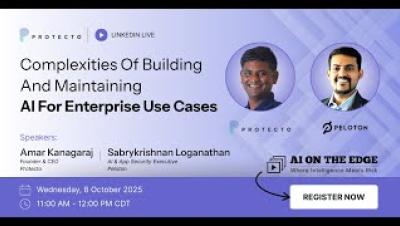
Only 1% Get Enterprise AI Security Right - Are You One of Them?

Most companies think their AI is secure — but the truth is far more complex. In this episode of AI On The Edge, Amar Kanagaraj (Founder & CEO, Protecto) and Sabrykrishnan Loganathan (Strategy Advisor, Peloton Interactive) break down what really goes into building secure, trustworthy AI systems for enterprise. You’ll learn: This is your masterclass on enterprise AI security. Don’t be in the 99% — watch and join the top 1%.

Future Trends in AI and Data Privacy Regulations for 2025

AI is no longer a pilot project. In 2025 it sits inside support desks, developer tools, clinical workflows, loan underwriting, and public services. The regulatory landscape has shifted from paper policies to real-world evidence in production. Buyers, auditors, and regulators want to see controls in place where data flows and models are operational.

Closing the credential risk gap for AI agents using a browser

AI agents increasingly are completing real tasks in the browser, acting on behalf of employees, and connecting to the same systems humans rely on to get work done. This introduces a new security problem: AI agents require credentials – passwords, API keys, and one-time codes – to operate. As agents proliferate, the risk surface increases and it brings a variety of identity and access management challenges.

Rethinking Security Posture Assessments

Security posture assessments are a foundational part of any security program. They’re how organizations take stock of their defenses, evaluate coverage, and identify gaps. But in practice, many posture assessments have become stuck in a pattern. They follow the same checklist, occur on a set routine, and result in a static document that often doesn’t translate into real change. The problem isn’t that posture assessments are irrelevant.

Artificial Intelligence in Business: Value, Risk, and How to Put It to Work Safely

Leaders do not lack information; they lack the right signal at the right time, presented in a way they can trust. That is the promise of artificial intelligence in business, and also the source of its headaches. Used well, AI turns scattered activity into timely visibility. Used carelessly, it creates security questions, unpredictable outputs, and nervous legal teams. This guide lays out where AI reliably adds value inside a company, the security decisions that matter most, and a practical path to pilot, measure, and scale without drama.

How Exabeam Detects LLM Abuse for Google Cloud Model Armor

In this demo, see how the Exabeam New-Scale Security Operations Platform integrates with Google Cloud Model Armor to detect and stop abuse of large language models (LLMs). You’ll learn how Exabeam: Monitors AI activity for suspicious or malicious behavior Uses advanced analytics to spot LLM misuse in real time Helps security teams enforce responsible AI use policies Watch how Exabeam and Google Cloud work together to provide stronger visibility, detection, and protection against emerging threats targeting LLMs.

AI Adoption Is Outpacing Governance: Conversations on Managing AI Risk

Executives everywhere are under pressure to deploy AI fast — but our recent roundtable on AI risk, hosted by TEISS, revealed a growing concern: AI adoption is outpacing governance, and organisations are taking on more risk than they realise. While most enterprises have mature technical controls, many are missing visibility into how AI is being used — and by whom.

AI-Generated Attacks: What are They and How to Avoid Them?

AI-generated attacks, such as social engineering, phishing, deepfakes, malicious GPTs, data poisoning, and more, are disrupting the current security landscape speedily. But there are ways to avoid them and strengthen our defences with miniOrange IAM solutions.