Security | Threat Detection | Cyberattacks | DevSecOps | Compliance

Latest posts

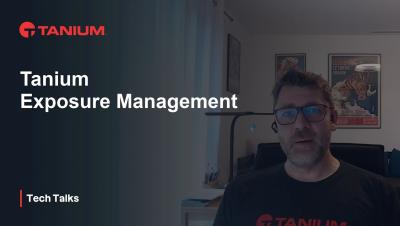
Exposure Management - Tanium Tech Talks #157

Exposure management goes beyond CVEs. In this Tech Talk, see how Tanium helps you identify, prioritize, and remediate real risk across vulnerabilities, misconfigurations, compliance gaps, and more. You'll see how Tanium: Goes beyond CVEs to include misconfigurations, compliance failures, certificates, and lateral movement Uses benchmarks, dashboards, and risk scoring to prioritize what actually matters Connects discovery and remediation - from compliance policies to third‑party app patching.


Why Your Human Risk Management Strategy Can't Ignore AI

AI isn’t just another technology wave—it’s a force multiplier for both innovation and risk. In a recent webinar featuring insights from Bryan Palma and guest speaker Jinan Budge, Vice President and Research Director at Forrester, one message came through clearly: the rise of AI and AI agents is fundamentally reshaping the human risk landscape—and security leaders need to move fast to keep up.

Introducing the workflow capability matrix

Ever wonder if you're getting the most out of intelligent workflows? Tines' workflow capability matrix (WCM) gives you a complete view of what's possible. The matrix enables you to audit your existing workflows and discover new ideas. By covering core capabilities across security and IT operations, the WCM ensures you're considering the full range of opportunities available. Capabilities covered in the matrix include.

Vulnerability Management as a Service: What Businesses Need to Know

Cyber threats are at an all-time high because the digital world is rapidly changing. Every day, new vulnerabilities are found in security systems. Attacks threaten businesses of all sizes by stealing data, disrupting operations, and damaging reputations. It has become clear that Vulnerability Management as a Service (VMaaS) is an effective managed approach for companies to protect their digital assets without managing security systems themselves.

Why a strategic MVP is needed for scalable software

Minimum Viable Product is the exact opposite of MVP in sports, the Most Valuable Player. One danger is to treat it as the latter by over-investing time and resources into it, missing the point that it's about validating the business idea and core value proposition. But, many also go too far the other way and under-bake the features, treat the core code as disposable, and end up later building the real product on top of a mistreated foundation with technical debt.

Cybersecurity Is Now an HR Issue, Not Just an IT Problem

As organizations become more digitally dependent, the traditional divide between cybersecurity and human resources is quietly dissolving. Cyber risk is no longer confined to firewalls and infrastructure, it lives in behavior, communication, hiring, and culture. The companies that recognize this shift are the ones building true resilience. Below are four expert perspectives that reveal how cybersecurity and HR are increasingly intertwined.

Tigera: Trust but Verify: Proving mTLS Is Actually Working Across Your Kubernetes Cluster

You enabled mTLS in your service mesh. The security team is satisfied-on paper. But how do you actually know it is working? When an auditor asks for proof that mTLS is enforced across namespaces, how do you provide the evidence? In this demo, we focus on the verification and troubleshooting side of mTLS that rarely gets enough attention. Using Istio Ambient Mesh and Calico's Unified Platform, we look at some common misconfigurations and how to fix them..

Tigera: Locking Down the Back Door: Egress Security for Kubernetes with DNS Policies and Egress Gateways

Most Kubernetes security efforts focus on what comes in-ingress rules, admission controllers, network policies for east-west traffic. But the back door is often left wide open. By default, every pod in your cluster can reach any IP address on the internet, and in many environments, that default is never changed. This is exactly the gap attackers exploit: a compromised workload with unrestricted egress can exfiltrate data, establish command-and-control channels, or pivot to external systems without triggering a single alert.

Tigera: From Experimentation to Production: What It Really Takes to Operationalize AI on Kubernetes

Every organization can get a model running in a notebook. The hard part is everything that comes after: promoting that model to a production service that is secure, observable, resilient, and governed. The gap between "it works on my laptop" and "it runs in production" is where most AI initiatives stall-not because of model quality, but because the platform is not ready.

Tigera: Beyond L4: Unlocking Layer 7 Traffic Management in Istio Ambient Mesh

You've successfully deployed Istio Ambient Mesh to secure pod-to-pod traffic with zero-trust mTLS-but now you need to layer in sophisticated Layer 7 controls. In this demo we show how you get L7 traffic management without reverting to sidecar injection. You will see how Waypoint Proxies are deployed per-namespace or per-service to handle advanced routing, while the ztunnel continues to manage mTLS at the node level. The result is a clean separation of concerns.