Security | Threat Detection | Cyberattacks | DevSecOps | Compliance

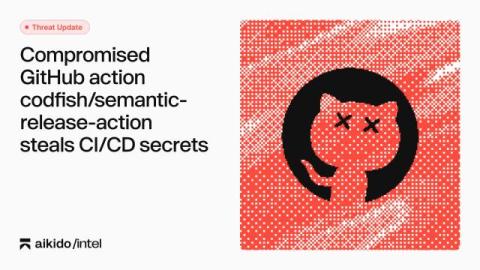
Compromised GitHub action codfish/semantic-release-action steals CI/CD secrets

On Jun 24, 2026, the codfish/semantic-release-action GitHub Action was compromised through an imposter commit attack. An attacker force-pushed two malicious commits into the repository and repointed sixteen tags to them, including the floating major version tags v2, v3, v4, and v5. Any workflow referencing the action by one of those tags will pull and run the attacker's code on its next CI run.

CI/CD Security Controls for Mobile App Pipelines: The DevOps Manager's Toolkit

You run the pipeline. You own the releases. And somewhere between the security team's findings and the development team's sprint, you're the one getting asked to explain why nothing is getting fixed. That's not a security problem. It's a coordination problem, and it's structural. According to the DuploCloud AI + DevOps Report, Sep 2025, The pipeline is under more pressure than it's ever been. The attack surface is wider than it's ever been.

10 DevSecOps Vulnerabilities That Can Compromise Your CI/CD Pipeline

The shift-left approach and prioritizing security from the very beginning of the coding process are what the tech industry talks endlessly about. Yet, many DevOps teams falsely believe that simply scanning code makes them secure. The harsh reality is that your CI/CD pipeline is rarely guarded with the same level of rigor and monitoring as the production environment it serves.

CI/CD Pipeline Security Tools and Technologies

CI/CD pipeline security is not a single tool decision. The pipeline spans source code, build systems, container registries, infrastructure configs, and production workloads. Each stage carries different risks and needs different controls. This guide covers the full stack of ci/cd pipeline security tools, the industry standards that govern them, and the CI/CD security best practices that make them work in production.

DevOps Services: What They Are, How They Work, and Why Your Business Needs Them

The way businesses build and deliver software has changed dramatically over the past decade. Gone are the days when development teams would work in isolation for months before handing off a product to operations staff for deployment. Today's competitive market demands speed, reliability, and continuous improvement - and that is exactly what DevOps services are designed to deliver.

Spotting CI/CD misconfigurations before the bots do: Securing GitHub Actions with Datadog IaC Security

In March 2026, a GitHub account called hackerbot-claw, describing itself as an “autonomous security research agent powered by claude-opus-4-5,” began systematically targeting open source repositories—including one from Datadog. Over a week, it opened many pull requests designed to exploit misconfigurations in GitHub Actions workflows.

CI/CD security: threat modeling using a MITRE-style threat matrix

Source code management (SCM) and CI/CD pipelines have become the industry standard for automating software delivery. But from the time a code change enters your SCM until it’s deployed, it’s susceptible to changes and reconfigurations that can go so far as to modify the pipeline itself. If you’re not proactively securing your CI/CD system, attackers can use it to grant themselves permissions, access secrets, and ship malicious code.

CI/CD security: How to secure your GitHub ecosystem

In Part 1 of this series, we discussed the CI/CD security boundary, mapped out potential attack vectors with a CI/CD threat matrix, and introduced a simple threat model focused on ideating detection workflows. In this post, we’ll apply these principles to a real-world source code management (SCM) tool example that every developer is familiar with: GitHub. In addition to threat modeling, we’ll also be taking a closer look at historical attacks on GitHub and GitHub Actions ecosystems.

Trusted AI Adoption (Part 1): Consolidation

Imagine your lead Software Engineer walks into your office and says, “Good news! I just deployed that critical update to production. I wrote the code on my personal laptop, didn’t run it through CI/CD, skipped the security scan, and just copied the files directly to the server with a USB drive.” You would fire them. Or you would revoke their access immediately.