How Hackers Get In: What Is a Vulnerability? (Containers Explained)

A vulnerability is a weakness in software—and in containerized environments, even one small flaw can open the door. From buggy code to outdated images and misconfigurations, risk can exist at every layer of the stack. And if a vulnerability is already known… attackers often already know how to exploit it. In this video, we break down: Next up: What is a CVE?
How to Detect Phishing Before It Happens: Moving Beyond User Awareness

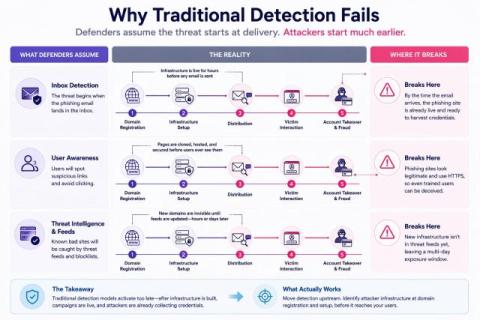
By the time a phishing email lands in an inbox, the attacker’s infrastructure has already been live for hours. That’s not a hypothetical. Zimperium’s 2024 research found that 60% of newly created phishing domains receive a TLS certificate within the first two hours of registration. The site is credentialed, hosted, and ready before most security teams have any signal it exists.

AI Threat Detection for Financial Services: Detecting AI-Driven Fraud and Data Exfiltration

A Tier 1 bank’s security architecture already spends heavily on detection. On one side sits the financial surveillance stack — fraud scoring platforms processing thirty thousand transactions an hour, AML monitoring watching money movement patterns, DLP engines scanning data in transit, payment anomaly detection tuned by a decade of production signal.

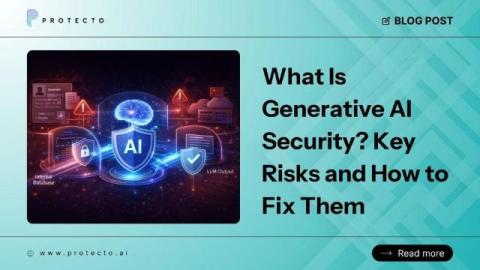
What Is Generative AI Security? Key Risks and How to Fix Them

Generative AI security is the practice of protecting the data that flows into AI systems, and the outputs those systems produce, from leaks, attacks, and unauthorized access. Every organization using AI today has the same blind spot. Sensitive data enters an AI pipeline, and most security teams have no visibility into where it goes next. An employee pastes a customer record into ChatGPT. A developer submits code containing API keys to an AI debugging tool.

Top 10 Governance, Risk, and Compliance (GRC) Software Solutions

Governance is breaking. Not because companies care less about risk, but because modern infrastructure moves faster than the controls designed to govern it. In 2026, governance has to keep up with cloud-native architectures, AI adoption, API sprawl, and the explosion of machine identities across production environments.

Stop Guessing: How to Define a Clear, Scalable Pricing Model for MDR Services

Many managed service providers (MSPs) recognize the value of managed detection and response (MDR) services, both for their clients and for their own business. However, they run into a recurring obstacle that slows adoption: how to structure a pricing model that is clear, sustainable, and scalable.

FedRAMP's June 2026 Rule Overhaul: CR26 Explained

The first quarter of 2026 is behind us, and that means the next wave of rules, program phases, and other shifts in governmental policy are starting to take effect. One that you may have seen mentioned coming soon is the Consolidated Rules update. What is CR26, when does it take effect, and what does it do? We’ve been eyeing this update for months now, because it makes some very exciting changes, so let’s go through it and see how it will affect the FedRAMP process.

An Introduction to the NIST Risk Management Framework (RMF)

While inherently critical to today’s businesses that run on data, implementing and enforcing data security and privacy has never been straightforward. Between collecting different types of sensitive data and deploying unique architectures, organizations cannot adopt a one-size-fits-all solution, meaning that every security architecture is unique.

Who's behind the agent? Security, trust, and compliance in agentic payments

We’ve been collaborating with others to explore how agentic commerce and enterprise agents will work. Alfonso Gómez-Jordana Mañas, co-founder of Crossmint shares his thoughts on the current state of payment security and how compliance mechanisms like KYC and AML need to evolve to support agentic commerce. OpenClaw provided users with an open-source framework to launch AI agents.