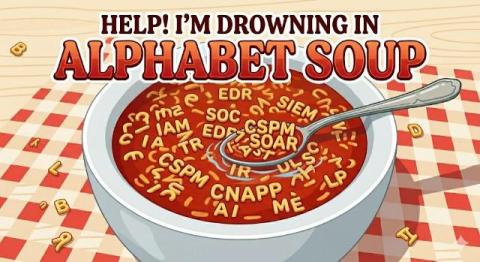
Help! I'm Drowning in Alphabet Soup

The cybersecurity industry is currently drowning in an “alphabet soup” of over 500 different category acronyms, a trend that is creating unnecessary noise and silos rather than helping practitioners. This hyper-niche branding often forces security teams to manage fragmented dashboards that don’t communicate with each other, adding to their workload instead of reducing it.
Beyond the Firewall: Growing Your MSP with NDR

A firewall is essential, but it’s no longer enough. Today’s attackers slip past perimeter controls, hide in encrypted traffic, and move fast once they get inside. Network Detection and Response (NDR) delivers always-on network visibility, earlier threat detection, and faster response, enabling you to see and stop what firewalls miss.

Why More Data Isn't the Answer: The Case for Analyst-Enriched Intelligence

More threat data does not always mean better security. With 83% of SOC teams struggling with alert volume, organisations need context, prioritisation, and human-led intelligence. Discover why analyst-enriched CTI is becoming the smarter choice in 2026. For years, cyber threat intelligence has been sold as a volume game. More feeds, more indicators, more data points, more dashboards. Some platforms now promote processing hundreds of billions of data points daily. On paper, that sounds impressive.

Critical Vulnerability Alert: CVE-2026-41940 in cPanel, WHM, and WP Squared

A critical vulnerability CVE-2026-41940 has been identified in cPanel, WHM, and WP Squared, affecting cPanel & WHM versions after 11.40, as well as WP Squared. These web hosting control panels are commonly used to manage websites, email, databases, and server configurations, making unauthorized access a serious security concern.

Shadow AI: The Silent Breach Already Inside Your Network

You locked down USB ports. You deployed web filtering. You trained your users on phishing. Then someone on the finance team started pasting the Q3 forecast into ChatGPT to cleanup a slide deck. That’s Shadow AI. It doesn’t need to crack your perimeter. It walks through the front door wearing your employee’s credentials. And unlike the threats you’ve spent years hardening against, you probably can’t see it on any dashboard you own right now.

Is your TPRM program an engine or an anchor?

In 2026, a slow assessment is a security risk. Every day spent in manual handoffs is a day of exposure for your organization. Join us at UpGuard Summit to see how our new Risk Automations engine transforms TPRM from a static checklist into an autonomous system. We will show you how to automate everything from vendor follow-ups to instant Jira routing for IT and Legal.

AI Agent Sandboxing for Healthcare: Why Standard Kubernetes Primitives Can't Express HIPAA Boundaries

Observe-to-enforce builds behavioral baselines from observed agent traffic — what tools the agent calls, which networks it reaches, which syscalls it executes — and converts them into per-agent enforcement policies. Baselines persist at the Deployment level because pods churn and the envelope has to outlive any single restart. The methodology runs as a four-stage progression: discovery, observation, selective enforcement, continuous least privilege.