Security | Threat Detection | Cyberattacks | DevSecOps | Compliance

Laravel-Lang Composer tag-rewrite Supply Chain Attack

On 2026-05-22, an attacker rewrote every repository tag across four Composer packages in the Laravel-Lang ecosystem to point at malicious commits. The affected packages are laravel-lang/lang, laravel-lang/attributes, laravel-lang/http-statuses, and laravel-lang/actions. The rewrite took place on 2026-05-22 into the early hours of 2026-05-23. Every malicious commit makes the same two-file change: one entry added to composer.json, and one new file at src/helpersphp.
Supply Chain Attack Targets Laravel-Lang Packages with Credential Stealer

On May 22, 2026, we detected an active supply chain attack against Laravel-Lang. We filed a report with the maintainers immediately. The attacker published malicious version tags across three widely used repositories, injecting credential-stealing code that loads automatically via composer’s autoloader feature. What makes this particularly sneaky is that the malicious code was never committed to the official repos at all.

CMMC Affirming Official: FCA Liability Explained

CMMC is one of the most modern cybersecurity frameworks out there, and while it’s limited to just the Department of Defense contractor chain, it’s still very important to know about it if you’re part of that ecosystem. After all, over 300,000 organizations are part of the defense ecosystem and DIB. The point of CMMC is simple: securing controlled unclassified information and federal contract information from top to bottom in the defense supply chain. The details are not so simple.

GenAI security management: Governing apps, agents and MCP servers through central policy

Author: Alexander Ivanyuk, Senior Director, Technology Generative AI in business is no longer just one chatbot in one browser tab. In many environments, it is already a mix of web-based AI apps, built-in assistants inside larger platforms, internal agents created for specific workflows and model context protocol (MCP)-connected tools that let AI reach documents, services and business systems beyond the model itself. That changes the conversation completely.

RAG vs Agentic AI: What's the Difference and Why Does It Matter for Security?

Security architects who understood the large language model (LLM) risk two years ago are now confronting a more complex problem. The enterprise AI stack has split into two distinct architectural patterns, retrieval-augmented generation (RAG) and agentic AI, and the security posture required for each is fundamentally different. Conflating them is how programs end up with coverage gaps.

Intelligent workflow automation: Where automation stops and intelligence starts

Automation works well until a step needs judgment, like an alert that needs context or an exception that doesn't match any rule. Those judgment steps are where the chain breaks, and where teams lose the capacity automation was supposed to give back. Intelligent workflow automation closes that gap. It orchestrates business processes across deterministic automation, AI for triage and decisions, and human-in-the-loop checkpoints in one workflow, so the ambiguous, judgment-driven steps don't break the chain.

Measuring AI-Enabled Success: 3 KPIs Leaders Should Track

AI represents a fundamental shift in how organizations work and innovate. It demands an equally fundamental shift in how technology leaders approach governance. Forward-looking leaders are moving beyond traditional gatekeeping by creating "paved roads": secure, pre-approved pathways that embed security controls, automated data protections, and real-time monitoring directly into AI workflows so teams can innovate rapidly within safe boundaries.

Securing AI agents: Why guardrail placement is a key design decision

When teams start building AI agents, especially with managed systems like Amazon Bedrock, they often wonder whether simply enabling guardrails is enough to secure their agents. A framework like Amazon Bedrock Guardrails provides a solid foundation for content filtering and policy enforcement, but having guardrails in place is only part of the equation.

Improve API authentication detection with Datadog

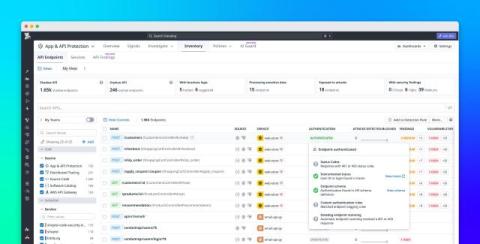
Many organizations have hundreds or thousands of API endpoints across their services, each of which handles authentication differently. For example, one service might rely on standard headers like Authorization: Bearer, while another uses an API key, and a third uses a custom JSON Web Token header with mechanisms or naming conventions specific to the team that built it.