Security | Threat Detection | Cyberattacks | DevSecOps | Compliance

Outsourcing Government Services: Essential Guide for Local Governments

Local governments often face the challenge of delivering quality services amidst budget constraints and increasing public demands. Outsourcing Government Services offers a strategic solution to enhance efficiency and reduce costs. However, the process of outsourcing requires careful consideration and planning to ensure it aligns with public expectations and regulatory requirements. This guide explores essential strategies, suitable services, potential challenges, and best practices for successful outsourcing initiatives, specifically tailored for local governments.


What Causes Parking Lot Trip and Fall Accidents in Philadelphia?

You step out of your car, look down for a second too late, and your foot catches on something that should not have been there. A broken curb, a pothole, pooled rainwater, loose gravel, a faded walkway, poor lighting. The fall happens fast. The aftermath does not. Pain sets in, then embarrassment, then bills, missed work, and the nagging question of whether this could have been prevented can be found at phillyslipandfallguys.

Penetration Testing vs Red Teaming: Choosing the Right Approach

When you're assessing a building's level of security, you're not just looking at one thing. It's great knowing that the front door has a series of unpickable locks bolted onto it, all of which have only one key in existence, but it's not really going to do anything if you're missing an entire external wall, essentially turning your living room into an open deck.

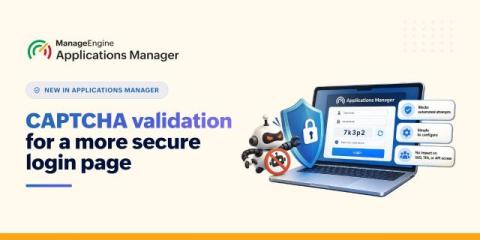
Protect Applications Manager logins with CAPTCHA validation

Login pages are one of the most attacked surfaces of any enterprise tool. They're often internet-facing, they're the front door to sensitive operational data, and unlike most vulnerabilities, they don't need to be discovered—they can simply be targeted with large volumes of automated attempts. For monitoring platforms like Applications Manager, which frequently sit with visibility into critical infrastructure, that front door matters even more.

Acronis Cyber Protect v17: Improving cyber resilience across people, data and infrastructure

Cyber resilience depends on more than recovery. Organizations need to protect critical data, empower users to recognize threats, maintain visibility across IT environments and ensure recovery is available when it matters most. Acronis Cyber Protect v17 Q3 2026 expands integrated cyber protection with new capabilities that strengthen security awareness, improve backup operations and extend protection across more virtual environments.

5 API Risks a Fully Tooled Marketplace Missed: Lessons From a Real PoC

If your team already runs API security tooling, you have probably answered the board’s question with a list: API discovery, testing, runtime protection, bot defense, perhaps a WAF or API gateway in front of it all. Every box is ticked. Yet the honest question every security leader still carries is harder to answer. Is anything getting through? That question has a specific answer, and it rarely comes from the tool inventory.

Put Threat Intelligence to Work

Threat intelligence is easy to find. Turning it into a detection that works in your environment is harder. A new campaign surfaces. Research lands in an inbox, threat feed, or repository. Then the real work starts. Someone has to identify the behaviors worth detecting, find the right telemetry, map the right attributes, build the logic, validate it, and tune it for the environment. That work takes expertise. And in many SOCs, that expertise sits with a small number of detection engineers.

Revoked Isn't Removed: The Supplier Exposure a Federal Ban Leaves Behind

Federal security restrictions and procurement bans have targeted Chinese telecommunications and technology suppliers for years. But removing a company's name from an authorization is not the same as removing the risk it carries into a supply chain. For C-SCRM programs, the harder question is identifying where that risk persists — through affiliates, resellers, data center tenancies, and proxy or sub-tier relationships that no order directly names.

Emerging Threat: (CVE-2026-94483) Next.js Server-Side Request Forgery via Image Optimization

CVE-2026-94483 is a server-side request forgery flaw in the Image Optimization feature of Next.js, the React framework maintained by Vercel. It is classified as CWE-918. Image Optimization fetches a remote image on the server and re-encodes it. Before fetching, it checks the requested URL against the images.remotePatterns allow-list. The flaw is that the allow-list check and the fetch resolve DNS separately, so a host that passes the check can resolve to a different address by the time the fetch happens.

Privileged user monitoring: Visibility without trust

Operations require elevated access and organizations grant it on trust, so privileged user monitoring has to turn that trust into evidence. An authorization record shows only that the system permitted an action. Monitoring produces a reviewable account of which elevated rights each person used and when, which lets an auditor or investigator test activity without disrupting administration.