Security | Threat Detection | Cyberattacks | DevSecOps | Compliance

The Deep Dive | The New AI Workforce: Governing Agentic Access with JumpCloud 04.24.2026

Join us for a look into Agentic IAM: treating AI as visible, governed workforce access. We’ll discuss our MVP focus on provisioning MCP servers through JumpCloud to register actors, control access to data, and audit activity—a secure starting point for agentic growth.
How to Identify and Reduce Excessive Permissions in AI Workloads

Your CIEM report came back clean this morning. Every AI agent in the cluster is exercising its granted permissions — no idle roles, no service accounts with broad scope and a handful of API calls behind them, nothing that looks obviously over-provisioned. The dashboard is green, and by the diagnostic your tool was built on, it should be.

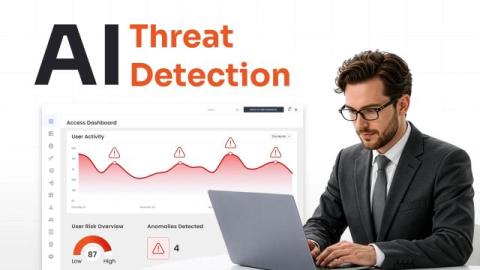
AI Threat Detection for Financial Services: Detecting AI-Driven Fraud and Data Exfiltration

A Tier 1 bank’s security architecture already spends heavily on detection. On one side sits the financial surveillance stack — fraud scoring platforms processing thirty thousand transactions an hour, AML monitoring watching money movement patterns, DLP engines scanning data in transit, payment anomaly detection tuned by a decade of production signal.

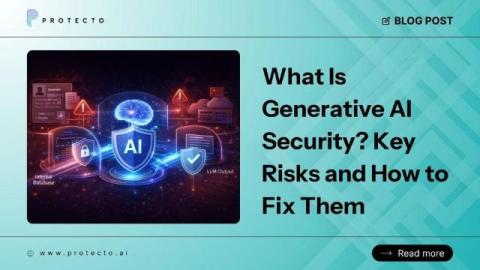
What Is Generative AI Security? Key Risks and How to Fix Them

Generative AI security is the practice of protecting the data that flows into AI systems, and the outputs those systems produce, from leaks, attacks, and unauthorized access. Every organization using AI today has the same blind spot. Sensitive data enters an AI pipeline, and most security teams have no visibility into where it goes next. An employee pastes a customer record into ChatGPT. A developer submits code containing API keys to an AI debugging tool.

How AI Threat Detection Stops Breaches Before They Happen: A No-Fluff Guide

What’s changed in the cybersecurity world after the advent of Artificial Intelligence (AI)? The speed of response has gone up. The Security Operations Center (SOC) and internal cybersecurity teams are able to detect, respond to, and mitigate attacks faster than ever. It’s a no-brainer that AI agents can neutralize identity-based attacks within seconds, before a human analyst checks the alerts.

The AI Bubble Is About to Burst (Here's Why)

The AI bubble is about to burst. Energy costs, chip shortages and computer pricing are reaching unsustainable levels. The economics don't add up anymore and something has to crack. In this episode of Razorwire Raw, Jim Rees explains why AI is hitting an economic wall nobody's talking about. World energy consumption is climbing vertically because of AI. Data centres are on hold because there isn't enough electricity. GPU, RAM and CPU prices are spiralling. Large language model providers are raising prices because compute costs are exploding.

Mythos and the cost of attacking

For twenty years, cybersecurity defense rested on a simple idea: make attacking so expensive that adversaries give up and move on. Cheap, capable AI breaks those economics. Recon, exploit development, phishing, and command-and-control infrastructure now run at model speed and cent-per-million-tokens cost. The detect-and-respond doctrine struggles when an attacker’s OODA loop compresses from weeks to seconds. The prevention bar has to rise from blocking known-bad to predicting intent from behavior.