Security | Threat Detection | Cyberattacks | DevSecOps | Compliance

Installed Your Travel eSIM on the Wrong Phone? What to Do Before You Delete Anything

A travel eSIM usually arrives as a QR code, which makes it easy to assume that the code can simply be scanned again on another phone if you choose the wrong device. That assumption can create a bigger problem. Many travel eSIM profiles are intended for one installation, and deleting the profile from the first device does not necessarily restore the QR code for use somewhere else. If you have installed an esim card on the wrong phone, the safest first move is not technical at all: stop changing things until you know whether the plan supports transfer or reinstallation.

The 5 Top Uses for Residential Proxies

Residential proxies route your traffic through real IP addresses assigned by actual ISPs to actual homes. That's the whole distinction that matters. A datacenter proxy comes from a server farm and looks nothing like normal traffic. A residential IP looks exactly like someone browsing from their living room, because, well, technically it is. That's why websites trust residential traffic more and block it far less. For anyone doing data collection, research, or account management at any real scale, that trust gap is basically the whole reason this category exists.

How AI Transcribing Is Changing the Way We Work With Audio

Audio is everywhere. We record meetings, interviews, lectures, and voice notes every day, yet most of it is never heard again. It takes hours to type a recording by hand, so many recordings are just left in a folder. AI transcription is changing that, with a service that converts speech into text in mere minutes. It is changing the way we work in the following ways.

SOC metrics that prove your security actually works

SOC metrics are quantifiable measures of how well a security operations center detects, investigates, and contains threats. The metrics that matter most are mean time to detect (MTTD), mean time to respond (MTTR), and incident closure rate, because together they show speed, effectiveness, and reliability, not just activity.

Securonix Introduces Advanced Behavioral Analytics to Detect Human and AI-Driven Threats

New solution uses behavioural intelligence and governed Agentic AI to uncover human and AI-driven threats while keeping analysts in control, backed by new ISO/IEC 42001:2023 certification for responsible AI management.

Insignary Launches Clarity AIR to Detect Undeclared Open-Source and AI-Written Code

Insignary Launches Clarity AIR: Closing the Blind Spot Between What Your Developers Declare and What's Actually in Your Code. New snippet-level scanning shows security and compliance leaders which open-source code and which AI-written code never made it into a manifest.

Proactive Security in Action Across the CrowdStrike Falcon Platform

Proactive security starts with understanding the environment before an attacker can take advantage of it. In this demo, see how the CrowdStrike Falcon platform brings together proactive telemetry and context across endpoint, cloud, identity, network, applications, SaaS, and more to build a connected view of risk.

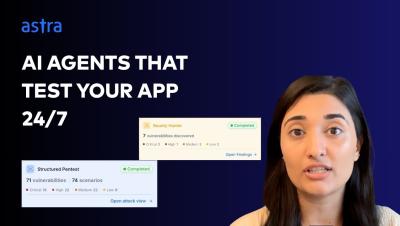
Autonomous Pentesting: AI Agents That Test Your App 24/7

Most companies pentest their app once a year. Hackers look for new backdoors every single day. Astra Autonomous Pentesting closes that gap with AI security agents that test your web app continuously, 24/7. Traditional penetration testing gives you a giant report full of jargon that sits on a shelf. Astra works like a friendly hacker that never sleeps. When it finds a security weakness, it doesn't just send a scary alert. It explains the exact problem, with the attack story and proof, so clearly that AI coding tools can fix, test and repair the vulnerability the same day.

How Modern Threat Actors Are Changing the Defense-in-Depth Playbook - Webinar October 8, 2026

Ransomware is still growing, but payouts are shrinking. Enterprises got better at backups, so attackers moved to where defenses are thinner: SaaS, identity, and stolen credentials. Infostealers do the collecting at scale, and AI is widening the gap. Credentials for AI services were the fastest growing category of leaked secrets in 2025, up 81% year over year with 1.27 million exposed (State of Secrets Sprawl 2026). Most defense-in-depth programs were not built with this attack chain in mind.