Security | Threat Detection | Cyberattacks | DevSecOps | Compliance

State of Security Research Details Essential Strategies for the Year Ahead

This year, security teams face more challenges — old and new — and grapple with high rates of burnout. Cloud complexity, supply chain attacks and additional obstacles are pushing security teams to the limits, and inspiring new responses. New research points to key strategies that will help organizations weather the complex challenges and attacks ahead.

You Bet Your Lsass: Hunting LSASS Access

One of the most commonly used techniques is to dump credentials after gaining initial access. Adversaries will use one of many ways, but most commonly Mimikatz is used. Whether it be with PowerShell Invoke-Mimikatz, Cobalt Strike’s Mimikatz implementation, or a custom version. All of these methods have a commonality: targeting LSASS.

What is the Most Vulnerable Data My Company Holds?

Data security is on every priority list in 2022. With the frequency of breaches never higher, many businesses assess their situation and ask cybersecurity questions. With cybersecurity policy, everything boils down to risk. Ultimately, every decision-maker wants to know, “how likely are we to be attacked?” Many believe cybercriminals only target certain kinds of data. Sensitive information, high-value financial data, and medical records are all widely accepted to carry a high risk.

Using Log Management as a Security Analytics Platform

With the rising tide of data breach awareness, your senior leadership is asking you to mitigate cybersecurity risk with security analytics. You’ve built up the use cases and started researching different platforms. Then, you realized: you’re not sure you have the budget. The typical security analytics platforms come with upfront technology costs as well as the “hidden fees” associated with training your team members. You know you need to use analytics to help mitigate risk.

Splunk Releases Add-On for Google Workspace Security Monitoring

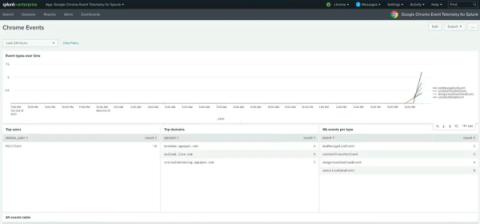
As the trend toward having a more distributed labor force working remotely part or full time persists, Splunk continues to see strong customer demand for more visibility into the security of the productivity and collaborative products their employees use. To assist with these requests, we’re excited to announce the release of Splunk Add-On for Google Workspace 2.0. This second major release includes important changes requested by our customers and valuable new functionality.

Security intelligence analytics: Planning Increases ROI

It’s been a week. A long week. After the most recent Board of Directors meeting, your senior leadership tasked you with finding a security analytics solution. Over the last month, you’ve worked with leadership to develop some basic use cases to determine which solution meets your security and budget needs. You started your research, but everything on the market seems really overwhelming. The Security Information and Event Management (SIEM) tools have the capabilities you want - and then some.

4 golden reasons for equipping your SOC with ManageEngine Log360

Cyberattacks are fast becoming a part of our daily lives. Multiple sources such as Norton Security and Forbes suggest that since the pandemic, attacks are not only increasing in number, but they are becoming more targeted and sophisticated. The attackers using Ransomware as a Service and double extortion techniques are prime examples of how sophisticated attacks are becoming these days. Norton Security states that there are more than 2,200 cyberattacks on a daily basis.

Detecting Spring4Shell 0-day Vulnerability Using Devo (updated 4/7/22)

Editor’s note: Latest update, April 6, 2022, 7:30 p.m. U.S. EDT — This post now includes an example query to aid SOC teams in generating alerts for their specific WAF data sources. See the section “Create New Web Application Firewall (WAF) Rules” for details. A critical zero-day vulnerability in Java’s popular Spring Core Framework is being actively targeted, according to multiple reports submitted to Bleeping Computer.

Building Your Security Analytics Use Cases

It’s time again for another meeting with senior leadership. You know that they will ask you the hard questions, like “how do you know that your detection and response times are ‘good enough’?” You think you’re doing a good job securing the organization. You haven’t had a security incident yet. At the same time, you also know that you have no way to prove your approach to security is working. You’re reading your threat intelligence feeds.