Security | Threat Detection | Cyberattacks | DevSecOps | Compliance

AEBA: Why Behavioral Analytics Has to Expand Beyond Humans

For years, security teams have built behavioral models around people. We learned that valid credentials only tell so much. A user can have legitimate access to a system and still behave in a way that deserves attention, which is why UEBA became such an important part of modern security operations today – intersecting data from multiple sources over extended periods of time to build a story indicating risk has become an essential tool to identify malicious actors, both insiders and outsiders.


Episode II: Attack of The Claudes

Two weeks after Hugging Face disclosed an AI-driven intrusion into part of its production infrastructure, Anthropic said it had found three incidents from its own cyber evaluations. Hugging Face traced its compromise through a data-processing pipeline, where a malicious dataset abused a remote-code dataset loader and a template-injection issue in a dataset configuration.

Introducing Real-Time Coaching in KnowBe4's AI-Native Security Awareness Training

Attackers are getting smarter. AI is making social engineering more convincing, more personalized, and harder to spot than ever before. Training the digital workforce, employees and agents, to recognize threats is necessary, but even the most security-conscious users can still make a mistake at the moment of risk. Workforce risk is a behavior change problem, and effective behavior change requires knowledge, pressure-tested application and real-time reinforcement all working together.

The Blind Spot: How "Bulletproof" Phishing Redirectors Slip Past SEGs

By Shikhar Dalela and Jeewan Singh Jalal The operators named the kit themselves. Buried inside compromised legitimate websites, the hidden staging directory is sometimes literally called “/.bulletproof”, and the PHP session cookie the kit sets on every visitor is named “bp_redir_sess.” The “bp” stands for bulletproof, which is an unusual degree of candor from a threat actor whose entire design philosophy is concealment.

How AI Governance Reduces Security Risks

AI governance reduces security risk by enforcing least-privilege access, protecting the data and credentials AI systems handle and making every AI action auditable. This matters because most organizations deploy AI faster than they can govern it. Employees adopt unsanctioned tools, and autonomous AI agents are created under existing user identities. Each one adds unmonitored machine identities that expand your attack surface – the exact gap that governance closes.

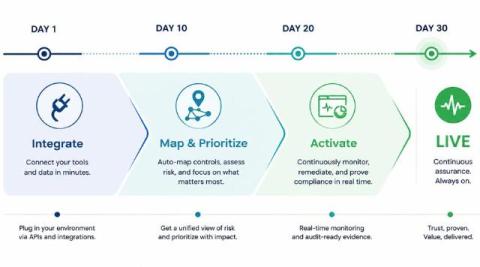
How to implement continuous control monitoring in 30 days

Continuous control monitoring may sound like a program you have to rebuild your whole GRC function to reach. It isn’t. It’s a phased build that integrates with the systems you already run, and a focused team can have continuous monitoring live across its priority controls in about a month.

What is Compliance Monitoring? Challenges, Solutions, Tools

As data privacy frameworks expand and operational risks evolve, security leaders and compliance officers face an ongoing challenge: Maintaining total visibility across employee activity, sensitive data, and internal controls without slowing down business operations. Compliance monitoring bridges the gap between policy and practice, giving organizations the proactive foresight needed to detect risks before they trigger costly violations.