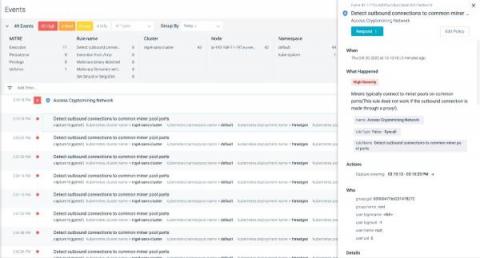
Detecting Cryptomining Attacks "in the Wild"

Cryptomining attacks are becoming more notable in-line with the rise of blockchain and cryptocurrencies, so detecting cryptomining has become a high priority. Security researchers have found data breaches related to various cryptominer binaries running within victims’ infrastructures. The default openness of Kubernetes clusters and the availability of the extensive compute power required for mining makes Kubernetes clusters a perfect target for cryptomining attacks.

Netskope Threat Coverage: Prestige Ransomware

In October 2022, a novel ransomware named Prestige was found targeting logistics and transportation sectors in Ukraine and Poland. According to Microsoft, victims affected by Prestige overlap with previous victims targeted by HermeticWiper, spotted in February 2022. The research also shows that the attackers deployed the ransomware within an hour between all victims, abusing highly privileged domain credentials to deploy the payload.

Behind the scenes: The making of a Global Threat Report

The first Elastic Global Threat Report was published earlier this week. In it, you will learn about trends observed by our threat researchers, our predictions for what’s coming next, and some of our recommendations to operate securely in the face of today’s and tomorrow’s threats. If you haven’t read it yet, go check it out. As a technical leader in Elastic Security, I'd like to reveal a small amount about what goes into reports like this one and why it’s significant.

The Term HACKER Is Not Derogatory Originally | Cyber Security

James Rees talks about hackers or the term HACKER was not derogatory originally, but now, they are malicious actors or cybercriminals. Connect with James Rees Hello, I am James Rees, the host of the Razorwire Podcast. This podcast brings you insights from leading cyber security professionals who dedicate their careers to making a hacker’s life that much more difficult.

80% of companies experience security incidents in the Cloud

Migrating to the Cloud brings many advantages for companies. First of all, they reduce their operating costs by almost 40%. They also increase their agility, reduce the maintenance time of traditional IT infrastructures, and gain flexibility and scalability. However, as the number of workloads deployed in the Cloud grows, more and more organizations are struggling to keep pace with security requirements.

Public Role in SQL Server

Database roles are similar to Windows groups — rather than revoking or granting access to each user separately, administrators manage access by granting or revoking permissions from roles and by changing role membership. Using roles makes it easier to accurately grant and revoke privileges for database users. And since multiple users can be members of a SQL database role, you can easily manage rights for a whole group of users at once.

Regulatory Compliance in the Telecom Industry

The increasing use of cell phones has automatically led to unimaginable height of sharing of personal information online. Most routine actions, from providing information over the phone to opening a bank account to placing food orders, may now be accomplished from the convenience of your own home. While the telecom sector has enabled remote procedures, it has also hastened the spread of identity fraud and financial schemes.

Internal Reconnaissance Protection using NetCease and SAMRi10

Internal reconnaissance is one of the first steps an attacker will take once they have compromised a user or computer account in your network. Using various tools or scripts, they enumerate and collect information that will help them identify what assets they should try to compromise next to get what they want. For example, BloodHound will map out attack paths that can enable an adversary to escalate their privileges from ordinary user to admin.

How to improve the employee experience while ensuring identity security

Employees in the post-lockdown world have bid goodbye to traditional work environments. Remote and hybrid work is the new normal, with employees expecting full access to their work resources even when working remotely. They might also use multiple devices, even personal ones, to access corporate data.