The Cost of False Positives: Why Cybersecurity Accuracy Matters

Cybersecurity is a high-stakes landscape, with very real threats of data breaches, malware, and other cyberattacks lurking around the corner. But detecting cyber threats is only half the battle—what happens when the threats you detect aren’t real? Enter the deceiving world of false positives—security alerts that incorrectly identify legitimate activity as malicious. While most security tools are designed to maximize detection, they often sacrifice accuracy in the process. The result?
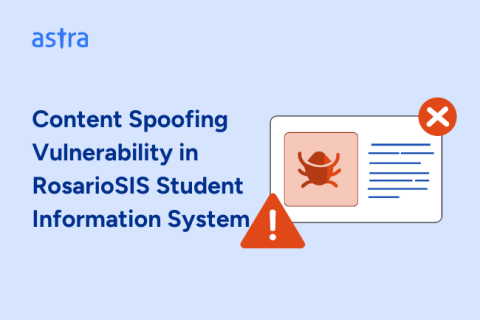
Content Spoofing Vulnerability in RosarioSIS Student Information System

Product Name: RosarioSIS Student Information System Vulnerability: Content Spoofing Vulnerable Version: v12.0.0 CVE: To Be Assigned The researchers from Astra’s security team, on March 4, 2025, discovered a content spoofing vulnerability in the Demo Web Application. This issue was identified in the “Theme” configuration under “My Preferences,” where improper user input validation allowed attackers to manipulate application settings.

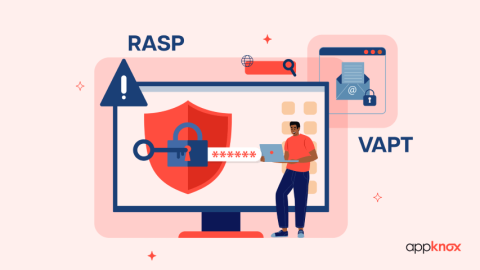
RASP vs. VAPT: Why You Need Both for Unbreakable Application Security

Imagine building a high-tech security fence around your house but leaving open doors and windows with crumbling roofs. Would you still feel safe? That’s precisely what happens when organizations deploy Runtime Application Self-Protection (RASP) without Vulnerability Assessment and Penetration Testing (VAPT). Many security leaders assume that because RASP offers real-time threat detection and mitigation, it eliminates the need for proactive security testing. But this is a dangerous misconception.

An early look at cryptographic watermarks for AI-generated content

Generative AI is reshaping many aspects of our lives, from how we work and learn, to how we play and interact. Given that it's Security Week, it's a good time to think about some of the unintended consequences of this information revolution and the role that we play in bringing them about.

Follow the Adversary: The Top 3 Red Team Exploitation Paths from 2024

Though 2024 may be behind us, many of the security threats and vulnerabilities that organizations faced last year remain. The CrowdStrike Professional Services Red Team tracks them all in its efforts to defend organizations against adversaries. The three most common exploitation paths we encountered were: In this blog, we break down these three critical exploitation paths, detailing how they occur and what steps organizations can take to mitigate them.

Understanding and Securing Exposed Ollama Instances

Ollama is an emerging open-source framework designed to run large language models (LLMs) locally. While it provides a flexible and efficient way to serve AI models, improper configurations can introduce serious security risks. Many organizations unknowingly expose Ollama instances to the internet, leaving them vulnerable to unauthorized access, data exfiltration, and adversarial manipulation.

Yonit Gruber-Hazani: Securing the Pipeline: Remediating CI/CD Vulnerabilities with SLSA | DevSecNext

Software supply chain attacks are on the rise, exploiting gaps in CI/CD pipelines to introduce malicious code. In this talk, Yonit Gruber-Hazani dives deep into common CI/CD vulnerabilities and how to mitigate them using the SLSA (Supply-chain Levels for Software Artifacts) framework. This talk was recorded at DevSecNext, a community-driven event reimagining how we share security insights—short, to the point, and packed with actionable takeaways.

regreSSHion in Perspective: Was It Worth the Hype

The regreSSHion vulnerability generated a lot of buzz and attention in mid-2024 that has since faded away. That’s in part because there’s no evidence that it was ever exploited. But, I argue it’s simply too dangerous not to patch, and that your vulnerability program needs to be flexible enough so that you can escalate exceptional cases like regreSSHion.

Take control of public AI application security with Cloudflare's Firewall for AI

Imagine building an LLM-powered assistant trained on your developer documentation and some internal guides to quickly help customers, reduce support workload, and improve user experience. Sounds great, right? But what if sensitive data, such as employee details or internal discussions, is included in the data used to train the LLM?