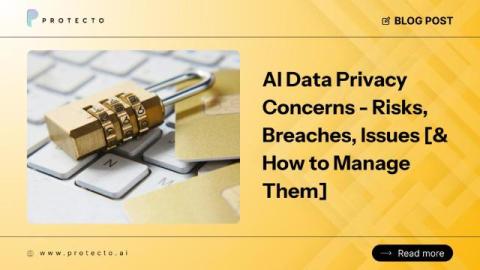
AI Data Privacy Concerns - Risks, Breaches, Issues in 2025

Data is moving faster than your controls. In 2024, AI privacy/security incidents jumped 56.4%, and 82% of breaches involve cloud systems; the same lanes your LLMs, agents, and RAG pipelines speed through every day. If you’re shipping GenAI inside a regulated org, you need guardrails that protect PII/PHI and IP without crushing context or tanking accuracy. Use this guide to.
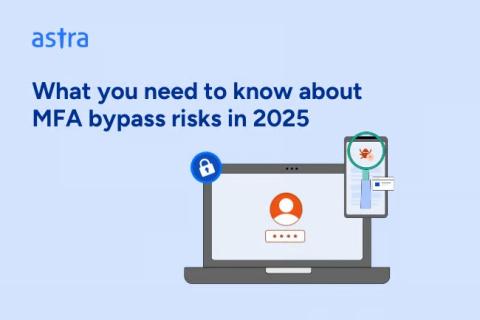

MFA Bypass Risks: What You Need to Know in 2025

In Uber’s 2022 breach, attackers didn’t crack encryption or exploit some unknown flaw. They flooded an employee with MFA prompts until they became exhausted. One careless tap, and an entire enterprise was open. The lesson isn’t that MFA failed. It’s that MFA itself can become the exploit surface. From AiTM phishing proxies like EvilGinx to automated OTP interception, attackers treat MFA like DevOps treats CI/CD, i.e, scalable, repeatable, and scriptable.

Threat Actors Are Increasingly Abusing Generative AI Tools for Phishing

Cybercriminals are increasingly abusing AI-assisted website generators to quickly craft convincing phishing sites, according to researchers at Palo Alto Networks’ Unit 42. In many cases, even when these services have safeguards in place to prevent abuse, criminals are able to bypass these measures in order to create phishing pages. Unit 42 tested a popular website generator to see how easy it was to spin up a spoofed website.

Architecting a Production-Grade Anti-Phishing Defense System with the NVIDIA NeMo Agent Toolkit and NIM

Konstantin (Kostya) Ostrovsky is the Chief Architect at Torq, where he leverages over 18 years of experience in software engineering and architecture. He specializes in cybersecurity, with a background that began with writing Windows Kernel Drivers. Konstantin is also a frequent speaker at software engineering conferences globally. Phishing attacks have evolved significantly in recent years, rendering traditional, rule-based defenses ineffective against sophisticated threats.

The Warning Signs You Can't Ignore: From Your Body to Your Business

We’ve all been there, pushing through a cold, a nagging pain, or a persistent feeling of being "off." We tell ourselves it’s nothing, that we’re too busy to slow down. I did the same thing, ignoring my body’s subtle whispers until they turned into a deafening roar. One moment, I was pushing through a typical day, and the next, I was in a hospital bed, a stark reminder that ignoring warning signs can have serious consequences.

How To Achieve Endpoint Visibility for Enhanced Endpoint Security

Endpoint visibility is fundamental to many of the processes that underpin effective endpoint security: data collection, monitoring, alerting (including alert analysis), and comprehensive threat detection and response. Trouble is, the number, types, locations, and use cases of endpoints are constantly in flux, due to user comings and goings, role changes, broad use of virtual instances and cloud-based workloads, Internet of Things (IoT) proliferation, hybrid work, and numerous other factors.

AI Data Privacy Concerns - Risks, Breaches, Issues in

Data is moving faster than your controls. In 2024, AI privacy/security incidents jumped 56.4%, and 82% of breaches involve cloud systems; the same lanes your LLMs, agents, and RAG pipelines speed through every day. If you’re shipping GenAI inside a regulated org, you need guardrails that protect PII/PHI and IP without crushing context or tanking accuracy. Use this guide to.

The Social Engineering Threats You Can't Ignore - And Why Most Are Inherently Mobile Problems

When most people think about cybersecurity, they picture firewalls, anti-virus software, and complex passwords. But the weakest link isn’t a server or a laptop—it’s a person. Social engineering attacks exploit human behavior rather than technical vulnerabilities, and four techniques dominate the landscape today: phishing, smishing, vishing, and quishing.

Managed WAF Done Right: Turning Security into CFO-Grade ROI

When CISOs and security teams evaluate a Web Application and API Protection (WAAP) platform, the conversation often starts and ends with technical capabilities. That focus is natural, but it does not reflect the full decision-making process in most enterprises. Security leaders may drive the evaluation, yet true adoption requires building consensus with finance and procurement teams who view the investment through a different lens.