Security | Threat Detection | Cyberattacks | DevSecOps | Compliance

ASOS Cyber Incident: CYJAX on the Third-Party Risk Facing UK Retailers.

On 6 October 2026, ASOS customers received an extortion message through the retailer's own app claiming its Snowflake instance had been compromised. CYJAX looks at what happened, why third-party and cloud platform risk sits at the centre of the incident, and how organisations can monitor their extended supply chain before attackers do. By now, most people in the UK will have heard about the cyber incident that hit ASOS on 6 October 2026.
Two Systems, One Truth: Unifying Training Records Across SAT and LMS

Somewhere in your security and compliance stack, there are records that prove your employees completed their security awareness training. But when these records need to serve as evidence, would they actually hold up to scrutiny? For many companies, the answer is no, and that’s becoming a major risk. Following steadily rising claims over the years, insurers have narrowed their coverage definitions and requiring stricter adherence to security standards.

Bell Integration Steps Up for The Cyber Helpline to Support Victims of Cybercrime

The Cyber Helpline is pleased to welcome Bell Integration as a new partner, supporting our work to help people affected by cybercrime, digital fraud and online harm. The partnership launched during Cybersecurity Awareness Month, with Bell employees supporting The Cyber Helpline through volunteering and fundraising throughout the year.

Cybersecurity Awareness Month 2026: Securing the Next 250 Years

This year, the United States of America celebrated their 250th birthday, but Cybersecurity Awareness Month is already looking toward the future with the goal of securing the next 250 years together. It’s an ambitious theme that leads us all to wonder, “what does it actually take to build security that lasts?” The Cybersecurity & Infrastructure Security Agency (CISA) 2026 Cybersecurity Awareness Month guidance begins with four familiar practices.

FIPS 140 2 End of Life: Impact on HSMs and Cryptographic Modules

The shift from the FIPS 140-2 standard is significant for organizations making use of HSMs, software-based cryptographic modules, VPN equipment, secure communications, and other items depending on validated crypto. That being said, it does not mean that the existing FIPS 140-2 modules will start malfunctioning or will become insecure. The transition has implications for how businesses will be appraising validated crypto devices, especially when purchasing or employing them in the new systems.

Zenity for Claude Tag: Securing the Shared Agent in Your Slack Workspace

Ask AI to Choose a prompt Write a TLDR of this post Explain the security risk Summarize what CISOs should know Your team just hired someone who never sleeps, reads everything, and takes work from whoever asks. That’s the elevator pitch for Claude Tag, and on the face of it, it’s hard to see why anyone would push back on the new hire. Enterprises will want this in every workspace.

Meet Dai Fujimoto: Building Zenity's Next Chapter in Japan

Japan’s Ministry of Finance reports that AI adoption in large local enterprises has surged to 89%. Companies are progressively choosing to incorporate AI agents into their workflows, building with Microsoft Copilot Studio, ChatGPT Enterprise, Claude, and a myriad of other platforms, all living across a variety of environments with autonomy, privilege, and minimal supervision.

Your AI Transformation Needs Runtime Protection for the Whole Agentic Estate

AI Detection and Response (AI-DR), also called AI runtime security, is quickly becoming a must-have. Prompt injection, jailbreaks, and data leakage are real, and the prompt is often where attacks begin. But the prompt is only the first hop. In an agentic enterprise, a single instruction can trigger activity well beyond the LLM, all the way to your business systems and data.

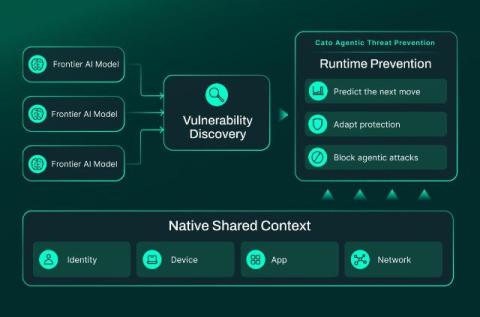
Beyond Model Access: Frontier AI Defense Needs Runtime Prevention

Access to powerful AI models is opening new possibilities for cybersecurity. Models can help uncover weaknesses, investigate threats, and explore how attackers might break into an environment. Using several models can bring different strengths to that work. But model access alone does not answer a critical question: can your defense stop an attack while it is happening? In the frontier AI era, discovery needs to connect to action.

Wait, Did We Just Invent Classifiers Again? Introducing Jev, a new way to do AI.

For the last few years, when somebody says “AI,” what they are usually referring to is a Large Language Model, or LLM for short. You chuck some text in, it has a think, and it gives you some more text back. This is brilliant if you want code written, documents summarised, or quantum physics explained to you in a limerick, but while this is great for humans, most software doesn’t actually want a beautifully written paragraph. Software just wants an answer so it can make a decision.