Security | Threat Detection | Cyberattacks | DevSecOps | Compliance

How Investment Firms Can Secure Trading Platforms With Keeper

Investment firms operate at the heart of global capital markets, managing assets, executing large volumes of transactions and relying on technology to transfer funds in real time. For all of this activity, investment firms rely on trading platforms, which are systems that route orders to alternative markets, analyze data, execute trades and measure performance across portfolios.

eBPF for AI Agent Enforcement: What Kernel-Level Security Catches (and What It Misses)

Your team deployed Tetragon six months ago. TracingPolicies are humming along—you’re catching unauthorized binary executions, blocking suspicious network connections, and generating seccomp profiles from observed behavior. Runtime security for your traditional workloads is solid. Then engineering ships their first autonomous AI agent into production. A LangChain agent connected to internal databases, external APIs through MCP tool runtimes, and a vector database for RAG.

Observe-to-Enforce: How Progressive Security Policies Reduce Blast Radius

Last Tuesday, your security architect opened a pull request to add network policies to the payments namespace. The PR sat for six days. Three engineers commented with variations of “how do we know this won’t break checkout?” Nobody could answer. The PR got marked “needs discussion” and moved to a backlog column where it joined the fourteen other security hardening tickets nobody will touch.

Securing AI Agents on GKE: Where gVisor, Workload Identity, and VPC Service Controls Stop Working

You enable GKE Sandbox on a dedicated node pool, bind Workload Identity Federation to your AI agent pods, wrap your data services in a VPC Service Controls perimeter, and deploy your agents with the Agent Sandbox CRD using warm pools for sub-second startup. Your security posture dashboard shows every control configured and active. And then an attacker uses prompt injection to trick an agent into exfiltrating sensitive data through API calls that every single one of those layers explicitly allows.

Secure the Supply Chain at Scale with Step Security and Seemplicity

CI/CD risks don’t get fixed on visibility alone. Step Security surfaces pipeline exposures, while Seemplicity turns them into clear, assigned remediation tasks, grouped by fix and owner, routed into existing workflows, and tracked through resolution, so teams can reduce exposure faster and prove progress.

Powering Wider Global DLP Coverage with Three New Detectors from Nightfall

‍A DLP solution is only as strong as what it can detect. Gaps in detector coverage aren't just a technical inconvenience; they're exposure windows. Every format that goes unrecognized is a policy that can't fire, a remediation that can't happen, and a breach waiting to occur. Three new detectors are now available in Nightfall: personal photos (selfies and headshots), Malaysian Driver's License numbers, and South African National ID numbers.

Awards Don't Defend Networks. Execution Does.

By: Simon Hunt, Chief Product Officer, Securonix Being named to CRN’s 2026 Security 100 list for the fourth consecutive year is something we’re proud of. It reflects the strength of our partners and the work our teams are doing every day. But recognition doesn’t stop a breach. It doesn’t reduce investigation time. It doesn’t help an analyst close a case faster at 2:00 a.m.

CVE-2025-53521: F5 BIG-IP APM Vulnerability Reclassified as Unauthenticated RCE and Exploited in the Wild

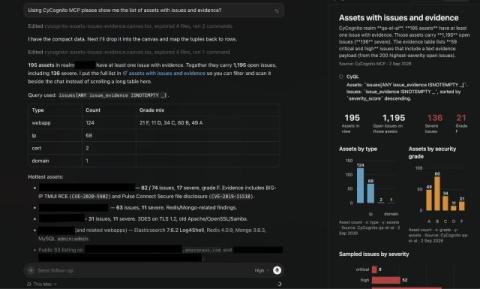
On March 28, 2026, F5 updated its security advisory for a vulnerability impacting BIG-IP APM that was originally disclosed in October 2025 (CVE-2025-53521). The vulnerability was initially classified as a medium-severity denial-of-service (DoS) issue but has been reclassified as a critical remote code execution (RCE) vulnerability. F5 has stated CVE-2025-53521 is being exploited by unauthenticated remote threat actors to deploy web shells.