Security | Threat Detection | Cyberattacks | DevSecOps | Compliance

How Conduent Lost 25 Million Records in 83 Days: The DLP Failure Everyone Missed

For 83 days, attackers moved freely through Conduent's systems and exfiltrated 8 terabytes of healthcare records, Social Security numbers, and personal data belonging to tens of millions of Americans. No alarm sounded. No transfer was blocked. The breach was discovered when systems stopped working. Not because anyone detected the data leaving.

How Netwrix DSPM complements Microsoft 365

Netwrix DSPM enhances Microsoft 365 security with unified data discovery, context-aware risk prioritization, automated remediation, and continuous compliance monitoring. While M365 provides foundational security through Purview and Entra ID, it lacks visibility into shadow data and automated risk response. Netwrix closes these gaps, helping organizations discover sensitive data, enforce least privilege, and respond faster to threats.

Defense: DLP alone can't protect your IP. Here's what can.

DLP and Secude solutions work alongside each other to protect your IP data from generation to storage and in transit. Here’s how. Submarine motors. Aircraft engines. Spatial systems. Command platforms. No matter the product, CAD software underpins the modern Defense production chain and contains Defense contractors’ most confidential intellectual property (IP).

Security Roles in SharePoint Architecture: SharePoint Security Matrix

Microsoft SharePoint has a mature, well-structured security model. It gives organizations control over who can access sites, libraries, and documents, and for most day-to-day needs, it works well. But there is a fundamental limitation built into how SharePoint security works: it controls access based on role, not on the sensitivity of the content itself.

Why Strong Digital Foundations Matter More Than Ever

Technology drives almost every modern business decision. From marketing automation to cloud storage, the systems that you have in place are going to shape how you operate, how you serve your customers, and how you compete. But as a business, you need to be able to adopt more tools, and you also need to realize that you face more risk. Growth today depends on more than just innovation; it depends on you having stability, credibility, and protection. If you want your business tech strategy to support long-term success, you need to make sure that you have a strong digital foundation to start with.

Recover any BitLocker-encrypted Windows device without per-device recovery keys

In enterprise Windows environments, BitLocker recovery often depends on storing and retrieving a unique 48-digit recovery password for every device. When these passwords are missing, outdated, or inaccessible, recovery becomes time-consuming and can lead to an irrecoverable data loss event. As device counts grow, this approach creates operational risk that IT teams cannot afford. In today's enterprise environments, encryption is only as strong as your recovery strategy.

Target Higher Education: Major University Data Breaches in 2025

In 2025, universities in the United States and Australia found themselves squarely in the crosshairs of persistent and evolving cyber threats. Higher education institutions manage highly sensitive personal information, financial details, healthcare records, and research data, making them prime targets for sophisticated attackers, ransomware gangs, and even hacktivists. As cybercrime escalates globally, the education sector is facing some of its most disruptive and consequential breaches in years.

Public Wi-Fi vs Secure Mobile Data: What Remote Workers Need to Know

You can work from almost anywhere today, cafés, airports, hotels, even park benches. Free public Wi-Fi makes it easy to jump online fast. But is it really safe? Many remote workers don't think about security until something goes wrong. One weak network can expose emails, client files, passwords, and payment details in minutes. On the other hand, secure mobile data offers more control and privacy-but may cost more. So which option should you trust with your work? In this guide, we'll break down the real risks, clear up common myths, and help you choose the safest connection for your remote setup.

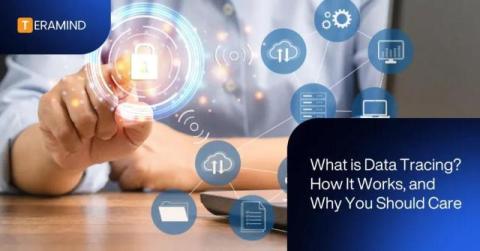
What is Data Tracing? How It Works, and Why You Should Care

Security logs tell you who accessed a system, but they won’t tell you where a CSV file went after someone exported it. Files move between apps, users, and third-party vendors without anyone truly tracking where they go, who touches them, or how they’re used. And that’s a massive problem when a breach happens, when auditors come knocking, or when you’re trying to tighten internal controls.

LLM Application for Protegrity AI Developer Edition

Securing LLM Workflows with Protegrity AI Developer Edition Learn how to protect sensitive data and prevent malicious prompt injections in your AI applications. In this technical walkthrough, Dan Johnson, Software Engineer at Protegrity, demonstrates a dual-gate security architecture designed to safeguard Large Language Models. Discover how to implement a security gateway that sits between your users and your LLM. This demonstration covers the integration of semantic guardrails and classification APIs to ensure data privacy and system integrity.

Jupyter Notebook for Protegrity AI Developer Edition

Want to test Protegrity’s data protection features without any local installation? In this tutorial, Dan Johnson shows you how to make your first protect and unprotect API calls directly in your browser using our interactive Jupyter Notebook (Binder). This is the fastest way to see Protegrity’s Python SDK in action—authenticating, applying protection policies, and maintaining data utility in real-time.

Top tips: What happens to your data after you click "Accept"

Top tips is a weekly column where we highlight what’s trending in the tech world and share ways to stay ahead. This week, we’re talking about a moment that’s become second nature to most of us. You open a website or install a new app. A banner appears. It’s long, filled with links, and clearly not meant to be read in a hurry. Your eyes jump straight to the familiar buttons. Accept all. One click, and you’re in. It feels harmless.

Redefining Data Security: From Insight to Action

Most organizations don't lack data security tools, they lack cohesion. Teams often layer DSPM solutions for discovery and classification on top of DLP tools for enforcement. On paper, this looks comprehensive. In practice, it creates friction: This is the platform problem: technology stitched together, not designed together. Solving it requires more than integrations, it requires a purpose-built platform that combines visibility, control, and action across all states of data.

Forensic Search & App Intelligence Add Up to Complete Insider Risk Visibility

Traditional data loss prevention stops at detection. You get an alert. You know something happened. But you don't see the full picture. When a departing engineer downloads your entire codebase over the holiday break, you need more than a policy violation. You need to see what they were doing before that moment, where the data came from, and what happened after. You need context, timeline, and the ability to trace every action.

Comprehensive Data Exfiltration Prevention: A New Architecture for Modern Threats

The exfiltration problem has evolved beyond what traditional DLP was designed to solve. Your employees work across personal AI assistants, multiple browsers, dozens of SaaS applications, and offline environments. They collaborate through Git, communicate via email clients, and store data on external drives. Each interaction represents a potential data loss vector—and legacy solutions can't see most of them.

The Nike Breach, Why Traditional DLP Failed, & What Security Teams Need Now

When WorldLeaks claimed to have exfiltrated 1.4TB of Nike's corporate data—188,347 files containing everything from product designs to manufacturing workflows—the incident revealed something more significant than another headline-grabbing breach. It exposed a fundamental gap in how organizations approach data loss prevention. The breach reportedly included technical packs, bills of materials, factory audits, strategic presentations, and six years of R&D archives.

The CISA ChatGPT Incident Makes the Case for AI-Native DLP

The acting director of America's Cybersecurity and Infrastructure Security Agency—the person tasked with defending federal networks against nation-state adversaries—triggered multiple automated security warnings by uploading sensitive government documents to ChatGPT. If this happened at CISA, it can happen at your organization too.

Entity Detection Plus Protection: Nightfall's New Approach to Comprehensive DLP

For years, data loss prevention has meant one thing: finding sensitive entities. Social Security numbers, credit card numbers, API keys—if you could pattern-match it, you could protect it. But this approach has always had fundamental limits. What happens when you need to protect customer IDs unique to your business? What about proprietary source code that doesn't contain any traditional PII?

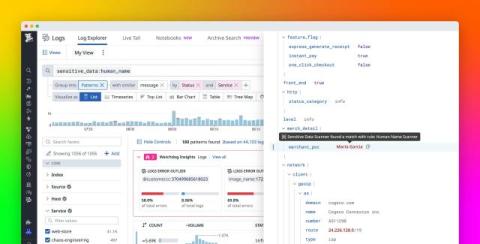
Detect human names in logs with ML in Sensitive Data Scanner

Modern applications generate a constant stream of logs, some of which carry more information than they should. For too many organizations, logs include personally identifiable information (PII) such as customer names that were never meant to leave production systems. Teams try to limit this data exposure by using regular expressions to detect and obfuscate matches, only to discover that names like John O’Connor, Mary-Jane, Jane van der Meer, and A. García slip through.