Security | Threat Detection | Cyberattacks | DevSecOps | Compliance

Inside Arctic Wolf and Anthropic's Trust-First Approach to the Agentic SOC

In the recently released 2026 SANS AI in Cybersecurity Survey, nearly two out of three security professionals said they have been given AI-generated guidance that later turned out to be wrong. Not from an experimental tool off in a sandbox, but from systems built into the security stack they were told to rely on. Security teams should not have to live with that.

A fully programmable secure web gateway

Every secure web gateway on the market works the same way: traffic matches a condition. A terminal action fires. Allow, Block, Isolate, Log. This model has been the foundation of network security for nearly 30 years, and it handles the common case well. But it has a ceiling, and customers with complex environments hit that ceiling regularly.

Sophos ITDR expands identity protection for the AI era

Sophos ITDR now delivers deeper AI identity visibility, expanded Microsoft support, faster response, and seamless deployment. Identity has become one of the most targeted attack surfaces in cybersecurity, with attackers increasingly relying on stolen credentials, compromised sessions, excessive privileges, and identity misconfigurations to gain access.

Introducing Evo Agentic AppSec: Security That Keeps Up With AI Development

AI is changing how software gets built. Coding agents produce more code than teams can review, and current models introduce several times more vulnerabilities per line than human developers. Many of those flaws involve business logic, access control, and authentication, areas where pattern-based scanners have limited visibility.

VulnBump: Can AI Agents Fix Vulnerable Dependencies Without Breaking the Build?

Can AI agents fix vulnerable dependencies without breaking the build? The fix itself is rarely the mystery. Over six months in 2026, Snyk Open Source recorded 459 million vulnerability findings across ~300,000 organizations. 94% of these vulnerabilities had a known fixed version, yet only about 10% had been resolved.

AI found the flaws. You don't need 1,000 contractors to fix them.

On October 14, 2026, Bank of America's CEO said the bank brought in 1,000 contractors to patch software flaws surfaced by frontier AI models, including Anthropic's Mythos. "We put on 1,000 contractors to help us do the patching work in the second quarter," Brian Moynihan told CNBC. Those contractors work on top of the 3,000 people the bank already has in that area (ITPro, The Next Web). That is what the new normal looks like.

Detection engineering meets AI-driven adversary emulation

In the first post in this series, Wade shared how our team laid the foundation for using AI in detection engineering. The short version is that an LLM doesn't know your stack. Without documentation and workflow context, it can produce plausible results that are difficult to trust, regardless of which model you use.

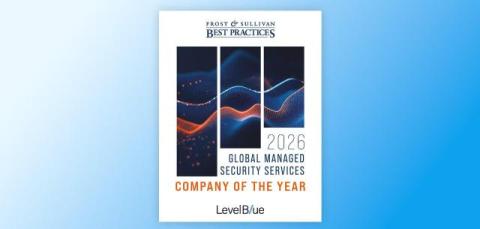
LevelBlue Named Frost & Sullivan's 2026 Global Company of the Year in Managed Security Services

Security teams face a demanding balancing act: keeping pace with evolving threats, managing complex environments, and demonstrating how their investments reduce risk. At LevelBlue, helping organizations meet those challenges is central to our work. That commitment is reflected in Frost & Sullivan’s recognition of LevelBlue as its 2026 Global Company of the Year in Managed Security Services.

What are the 5 pillars of Zero Trust? [Quick Question Ep. 4]

What are the five pillars of Zero Trust? Across Zero Trust frameworks, five control points remain consistent: users, devices, networks, applications, and data. In this episode of Quick Question, we cover how each pillar generates critical security data, and why that data often lives in disconnected tools, leaving organizations with a fragmented view.